
What Happens to God When the Ship Lands
🎙 Listen to the audio version
It started as a perfectly normal Tuesday.
Carol Briggs had the coffee going by 4:47 AM, which was three minutes late because the Bunn machine had developed what she could only describe as an attitude. She’d owned the Millfield Family Diner for eleven years. She knew every creak of the building, every flicker of the fluorescent tube above the pie case, every customer who’d walk in before 6 AM and in what order. Dale from the grain elevator, always first, always decaf, always pretending that was a real choice. Then the Kowalski brothers, then whoever was running the county road crew that week.
She was slicing the breakfast ham when the windows went white.
Not lightning. She’d lived in Ohio her whole life; she knew lightning. This was sustained. A white that didn’t stop, that pressed through the glass like something outside had decided to become the sun but hadn’t quite figured out the scale yet. The ham knife hit the cutting board and Carol walked to the front door on pure animal instinct, the kind that bypasses the part of your brain that would sensibly advise you to not.

She opened the door.
The object — and she would spend a long time in the coming weeks struggling with what word to use, because “object” felt too small and “ship” felt like she was narrating a movie — was about two miles out, over the soybean fields, and it was large the way mountains are large, which is to say your brain doesn’t immediately accept it as real because real things don’t come in that size. It made no sound. Or rather, it made the sound of everything else stopping. No wind. No birds. No semis on Route 30. Just the hum of her own refrigerator units, heroically continuing to refrigerate, because the compressors didn’t know they were supposed to have a moment.
Carol stood in the doorway of the Millfield Family Diner in her apron, holding a dish towel, and thought: well.
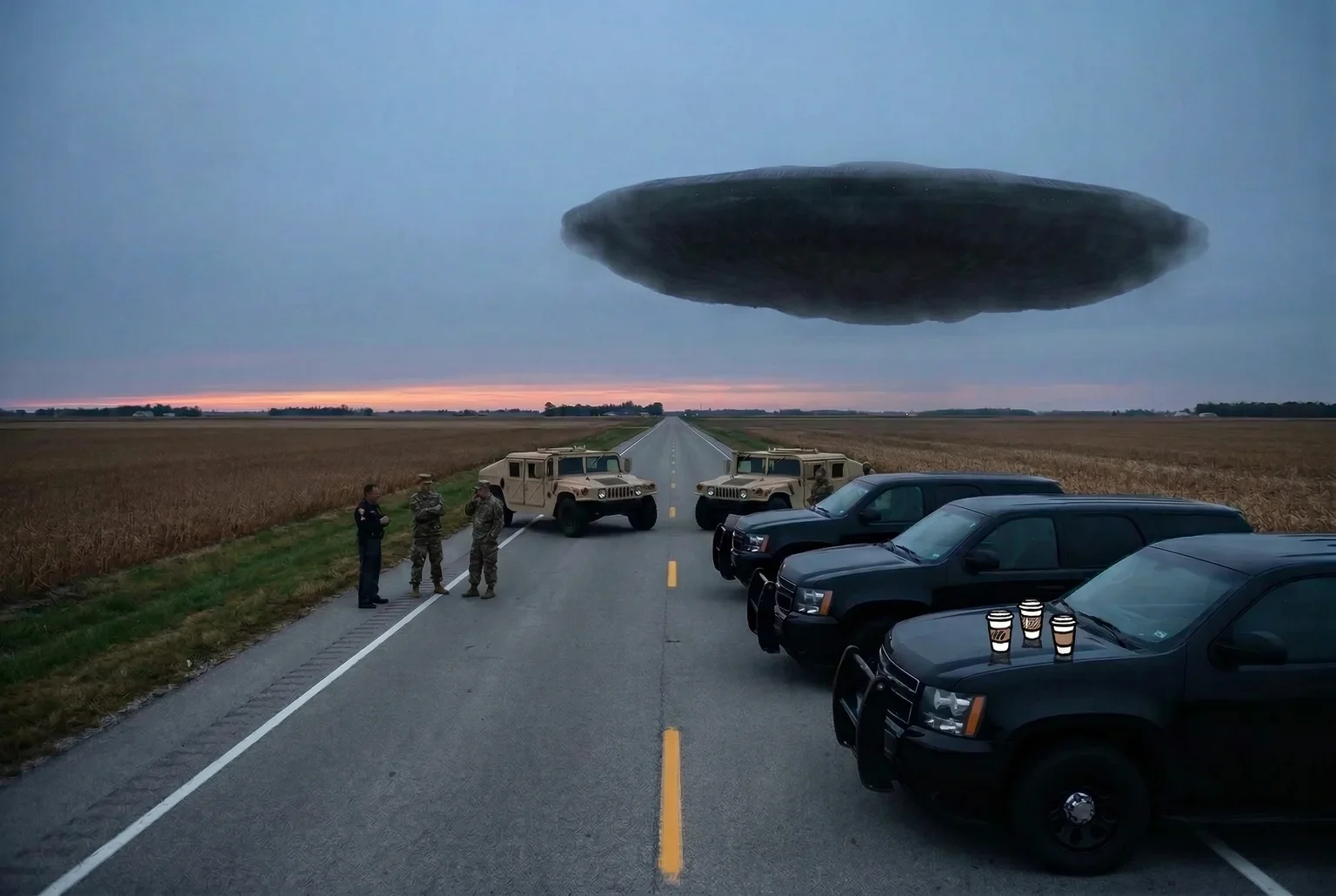
The military showed up about forty minutes later, which, honestly, good response time. Black SUVs first, then two Humvees, then a convoy of vehicles she didn’t have names for. They cordoned off Route 30 about a quarter mile east of her parking lot, which meant she was on the inside of the perimeter, which meant the next three hours involved several very serious young men in uniform asking her to please go back inside the diner and also, while she was in there, could she start making coffee because there were a lot of people out here.
She made six full pots. She charged them.
By 7 AM her phone was producing a sound she’d never heard before, which was the sound of approximately four hundred text messages arriving in ninety seconds. Her daughter in Columbus. Her sister in Dayton. A cousin she hadn’t spoken to since 2019. A group chat for the First Methodist Church of Millfield that had previously been used only to organize the spring potluck now contained 74 new messages and someone had typed, in all caps, REVELATION 19:11 followed by three fire emojis.
Twitter — she still called it Twitter — had opinions. So many opinions. The top post she saw, briefly, before the apps all started crashing, read: aliens saw our Yelp reviews and came anyway. respect honestly. It had 300,000 likes and was seven minutes old. Someone else wrote: it’s not a UFO anymore is it. It’s just an FO at this point. A news chyron visible on her phone’s livestream of CNN read, with what she felt was admirable journalistic restraint, LARGE CRAFT OF UNKNOWN ORIGIN OVER OHIO, followed immediately by a lower-third that said MARKETS PAUSE TRADING.
Good, she thought. Good, the markets are pausing. The markets should take a beat here.

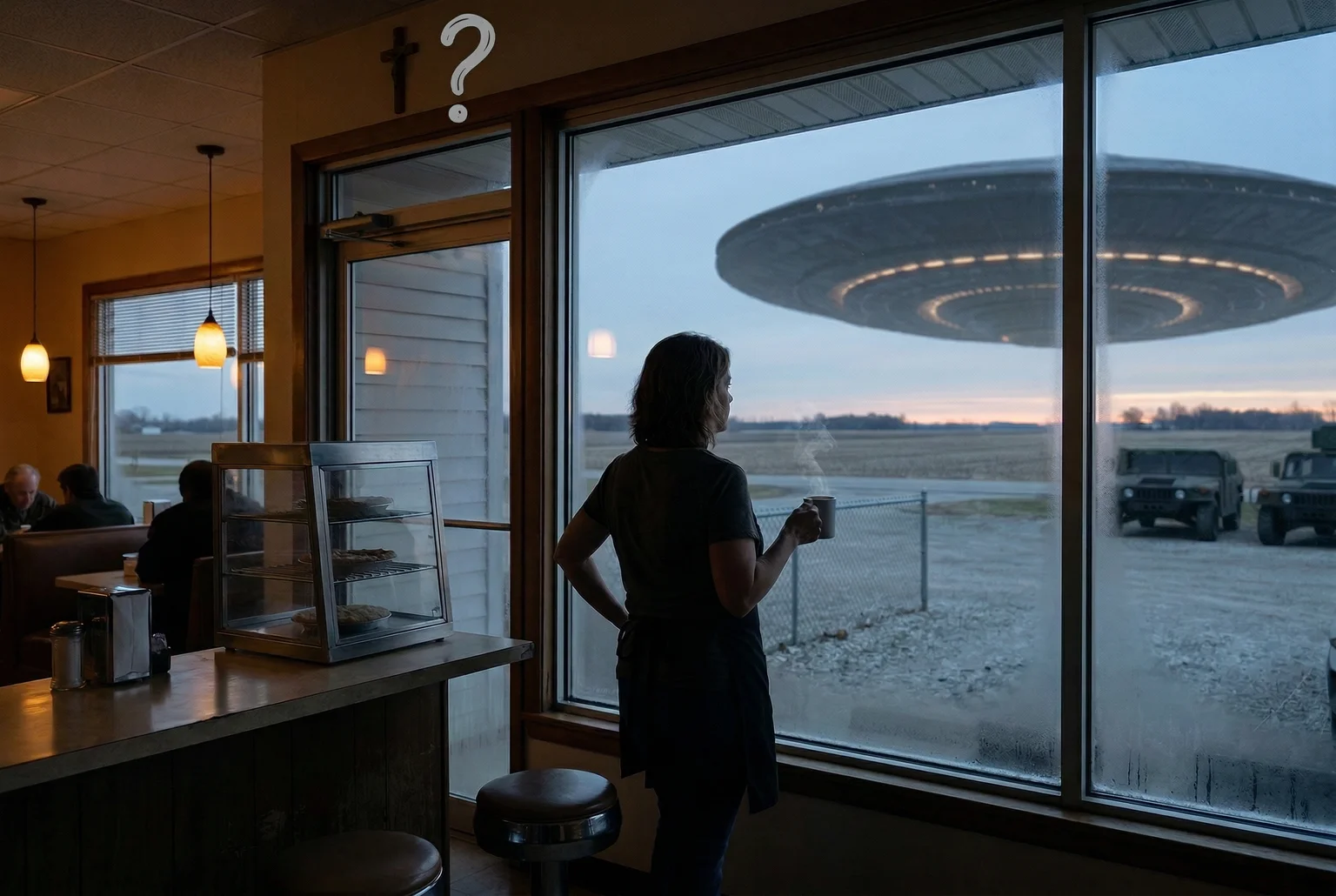
She refilled the soldiers’ mugs. She sliced a pie — peach, the Wednesday pie, though she wasn’t sure Wednesday was coming in any normal sense — and stood at the window and looked out at the thing in the sky, which had not moved, and did not look like it was planning to.
And here is the part that surprised her, later, when she tried to explain it to her daughter. It wasn’t fear, exactly. It was the specific, vertiginous feeling of a question she’d never thought to ask suddenly becoming the most important question in the room. Carol Briggs was Methodist. Had been her whole life, same church her mother went to, same church her kids were baptized in, same building where she’d sat in the third pew on the left for forty-plus years and never once doubted that the universe had a shape she understood. God made it. God made us. There was a plan.
But that thing out over the soybean fields had not been made for us. Or if it had, the plan was considerably larger and stranger than anything Pastor Dennis had prepared her for.
She stood at the window of her diner, watching the U.S. military set up a forward position in her parking lot, and thought about the third pew on the left, and the small wooden cross above the door, and the way Pastor Dennis said all of creation every Sunday like it was a thing with a size you could picture.
The coffee machine beeped. Ready for pot number seven.
“Yeah,” said Carol, to nobody in particular. “Same.”
The Question Nobody Was Ready For
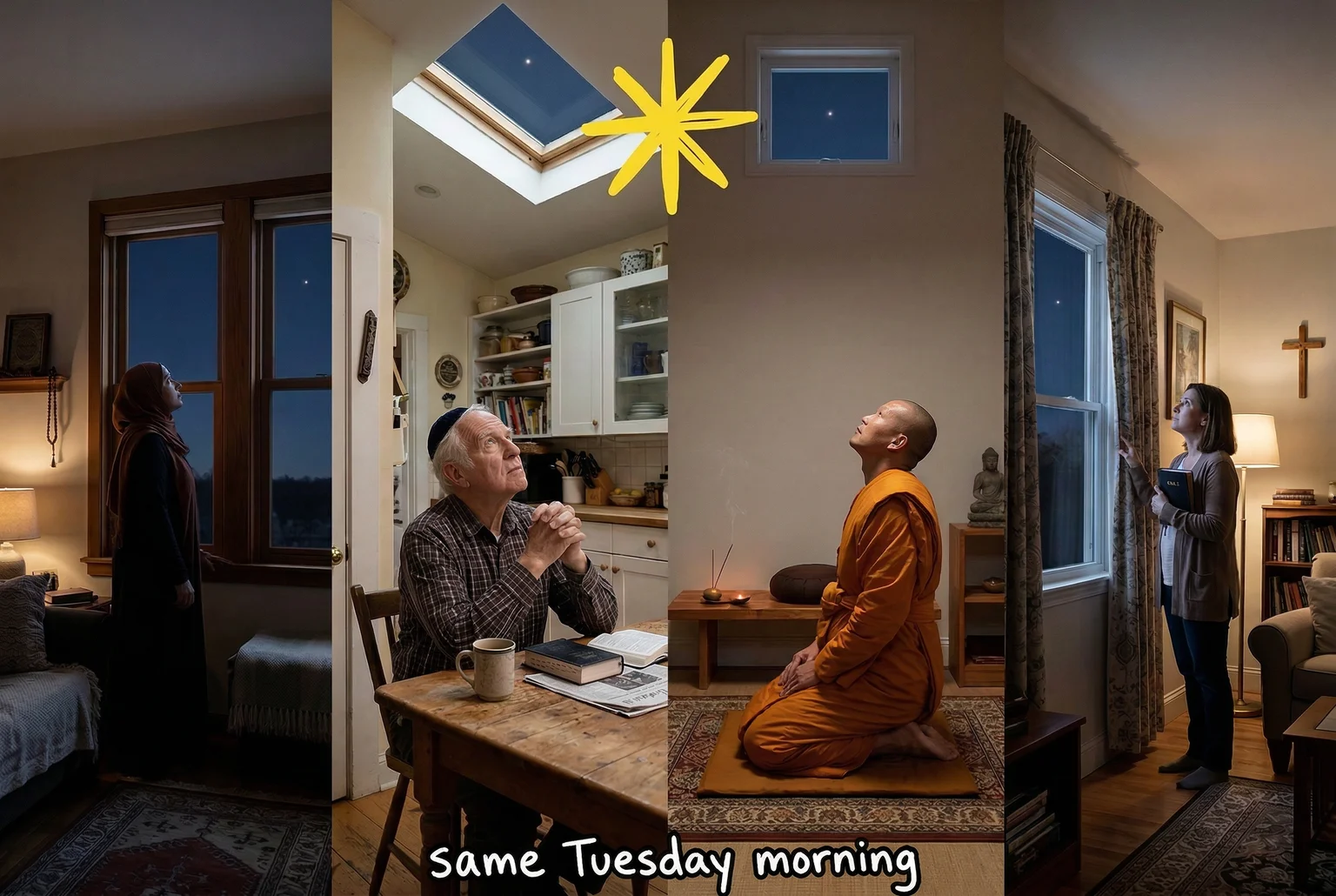
Here’s the thing about Carol’s crisis, standing at that window with pot number seven brewing. It wasn’t unique. Right at that moment, approximately 4.2 billion people with active religious beliefs were having a version of the same moment, scaled to their own living room, their own theology, their own particular flavor of wait, but what does this mean.
And the answer — annoyingly, fascinatingly — is different for every one of them.
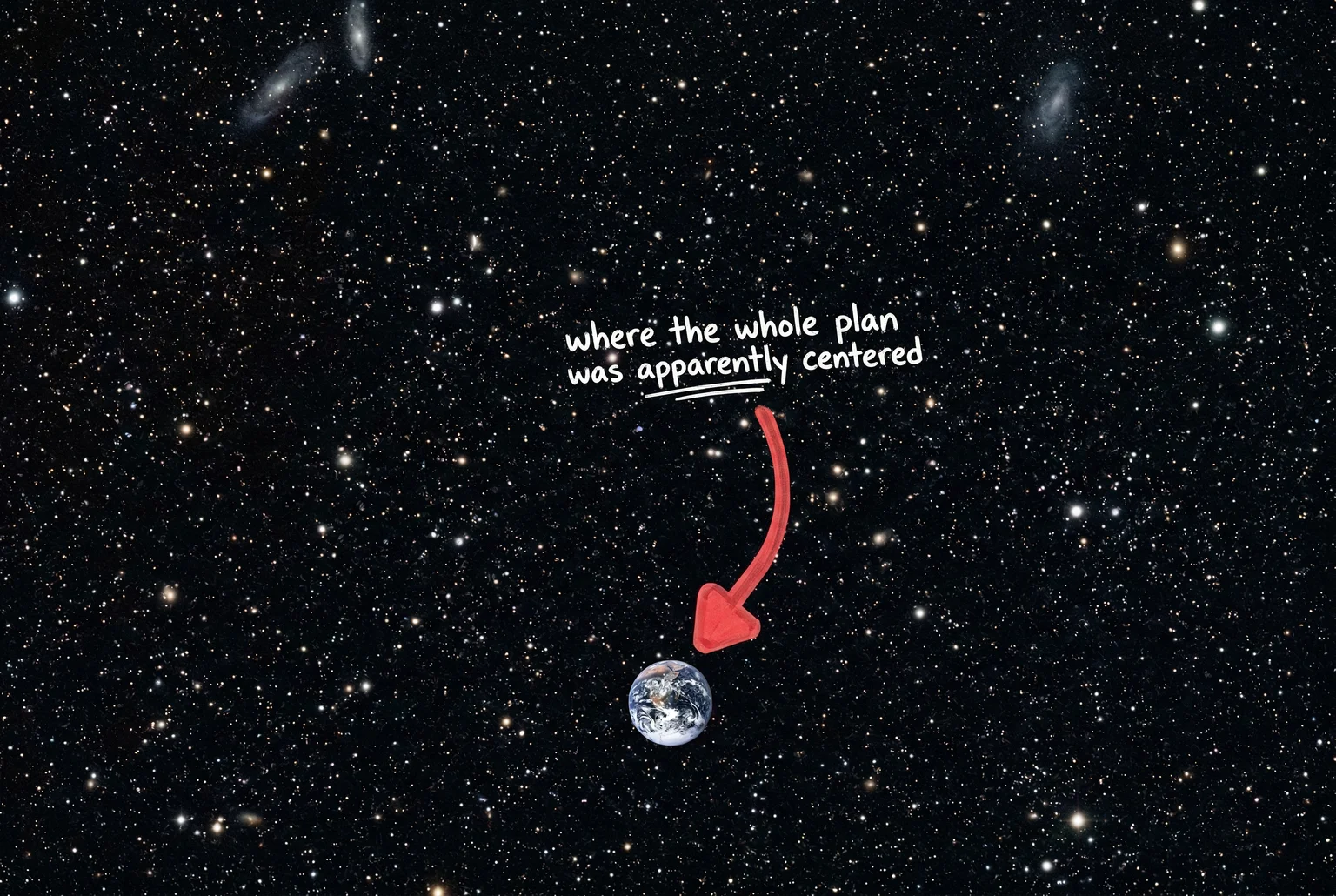
Because confirmed extraterrestrial intelligence doesn’t just poke science. Science, honestly, would be fine. Physicists would be thrilled. Science has been half-expecting this for decades; they’d have a press conference ready in six hours and a peer-reviewed paper draft by Thursday. No, the entity that really takes the hit here is the foundational assumption buried inside almost every major religious tradition on Earth: that we are the point.
Not “we” like all carbon-based life. “We” like humans specifically. Made in God’s image. The crown of creation. The species for whom the entire universe — all 93 billion light-years of it — was apparently constructed as a backdrop. The theological term for this is anthropocentrism, and it is, depending on your tradition, either a core doctrine, a reasonable inference, or something your scripture strongly implies without quite spelling out. Either way, it’s doing a LOT of heavy lifting in the world’s major religions, and it does not survive Tuesday morning in Millfield, Ohio, without taking some serious structural damage.
This has happened before, by the way. The Catholic Church spent a good stretch of the 1600s being very upset about heliocentrism, because putting the sun at the center of the solar system implied the Earth wasn’t cosmically special, which implied we weren’t cosmically special, which was a theological problem with Galileo’s name on it. [27] Then came Darwin, and the whole process repeated with extra anguish. Both times, the institutions initially resisted, then reinterpreted, then quietly updated the brochure. The facts won and the theology adapted, like it always does, just slowly enough to be embarrassing. [28]
Alien contact would be Galileo times a thousand, wearing a spacesuit, hovering over a soybean field.
The question isn’t whether the world’s religions would survive it. Most of them probably would, in some form. Institutions are stubborn; they have a long history of outlasting the things that were supposed to kill them. The question is how each tradition would metabolize the shock: which ones bend, which ones fracture, which ones look at the spacecraft and say, with genuine calm, “yes, we knew about this.” [16]

Some would scramble. Some would surprise you. And a few billion people who don’t fit neatly into any existing tradition might do something else entirely — something new, something strange, something that starts as a group chat and ends up with its own hymns.
Let’s go through it.
The Vatican Has Thought About This (They’d Baptize Them)
Christianity, specifically Catholicism, has a PR problem with alien contact that goes deeper than the obvious awkwardness. It’s structural.
The whole architecture of Christian salvation theology — original sin, the Incarnation, the atonement, the sacraments — was built around one species, on one planet, with one catastrophic ancestor who made one catastrophic choice in a garden. Adam ate the fruit. Sin entered the world. God became human to fix it. The Church administers the fix via baptism and the sacraments. Clean, elegant, internally consistent. It works great as long as humanity is the only rational species in the universe.
Then the ship lands in Ohio.
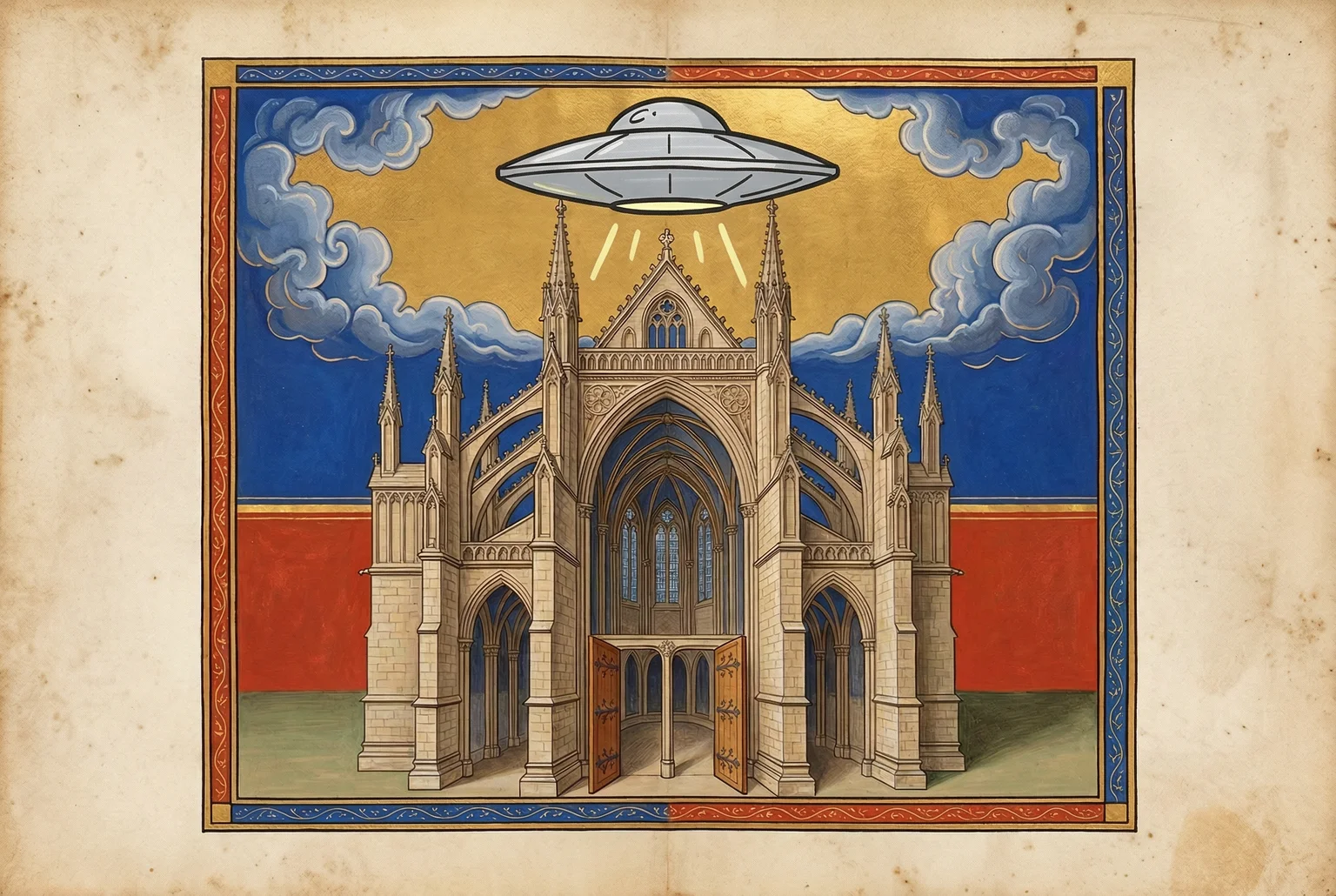
Here’s what makes this genuinely interesting rather than just a gotcha: the question isn’t whether God exists, or whether Jesus was real. Those are articles of faith that no spacecraft can technically disprove. The question is much more specific and much more thorny. It’s this: did Adam’s fall apply to them?
Christian theology, particularly Catholic theology, holds that original sin is inherited by all human beings through descent from Adam. [30] The Catechism is clear on this. St. Paul is clear on this: “sin entered the world through one man.” [33] Great. But the beings stepping off that spacecraft are not descended from Adam. They didn’t eat the fruit. They may have never heard of the fruit. So are they fallen? Are they sinless? Are they in some third category that the Council of Trent didn’t have a working group for?
C.S. Lewis (who gets credit for being one of the few serious Christian thinkers to engage this question before it became urgent) laid out five things he’d need to know about any alien species before deciding what their theological status was. [35] Are they animals? Do they have rational souls? Have they fallen? Have they been redeemed? What’s their current spiritual state? His point was basically: don’t panic, work through it methodically. Classic Lewis. Very calm man about very alarming hypotheticals.
The problem is that his questions, applied to actual aliens standing in front of you, stop being theoretical very fast.
Because if the aliens have rational souls. How you’d test for this is anyone’s guess, but let’s say they’re clearly intelligent, clearly moral, clearly something more than a very large iguana; then Christian theology has a real dilemma on its hands. [32] Rational souls need salvation. Salvation, in the Catholic framework, comes through Christ’s atonement. Christ’s atonement was a single, unrepeatable event: God taking on human nature, dying, rising, done. [30] The question certain theologians have quietly been losing sleep over is whether an atonement in human nature automatically covers beings who are not human, and if it doesn’t, whether God would need to do it again: show up on their planet, take on their nature, and run the whole sequence again.
Some theologians think yes, that’s fine, that’s a coherent idea. [32] Others find this deeply uncomfortable, because it seems to undercut the “once for all” finality that the New Testament goes out of its way to emphasize. [33] Nobody has a clean answer. Notably, nobody had to have a clean answer until about thirty seconds ago.
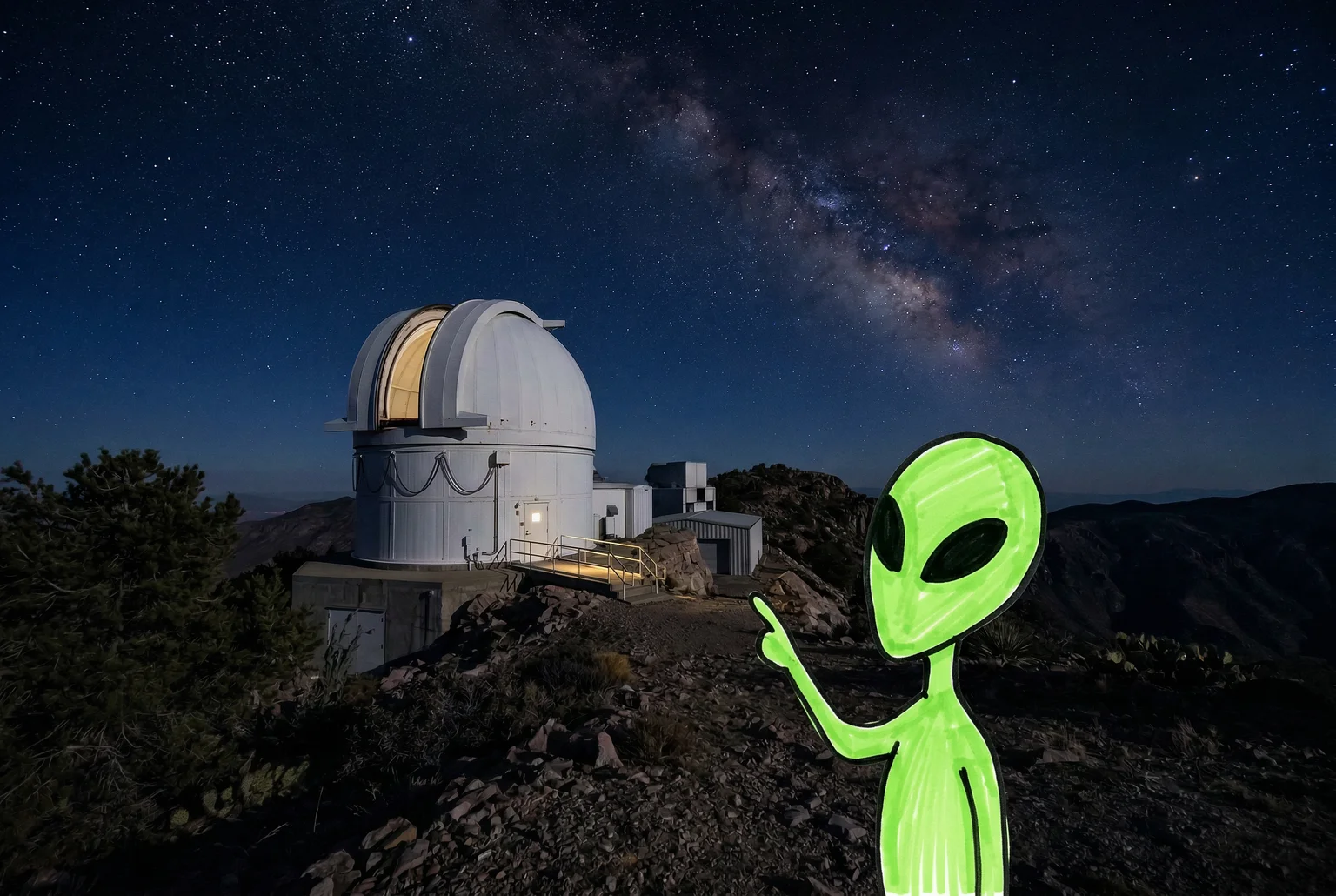
Now here’s where it gets genuinely surprising, because the Vatican has actually engaged this question; not after the landing, but years before it. Brother Guy Consolmagno, the Vatican’s chief astronomer (which is a job that exists and is not a bit), said publicly that he would baptize an extraterrestrial if it asked. [38] [39] Fr. José Gabriel Funes, a former Vatican Observatory director, gave an interview in which he said aliens could exist and even be closer to God than humans are; that the universe being full of other beings didn’t threaten his faith at all. [25] Pope Francis, in his cheerfully chaotic way, made rhetorical remarks about baptizing Martians if they came to him requesting it. [40]
These aren’t fringe positions. These are people inside the institution doing genuine theological heavy lifting, trying to reconcile 2,000 years of doctrine with the very real possibility of company.
The evangelical wing of Christianity has its own version of this headache, and it’s arguably worse. The Great Commission, “go and make disciples of all nations”, has typically been understood as: all human nations. But if you believe aliens have souls, and souls can be lost, and Christ is the only way, then the logic of missional theology doesn’t stop at the atmosphere. [34] You are, technically, obligated to evangelize them. [43] Picture the planning meeting. Picture the missions committee. Picture the budget discussion.
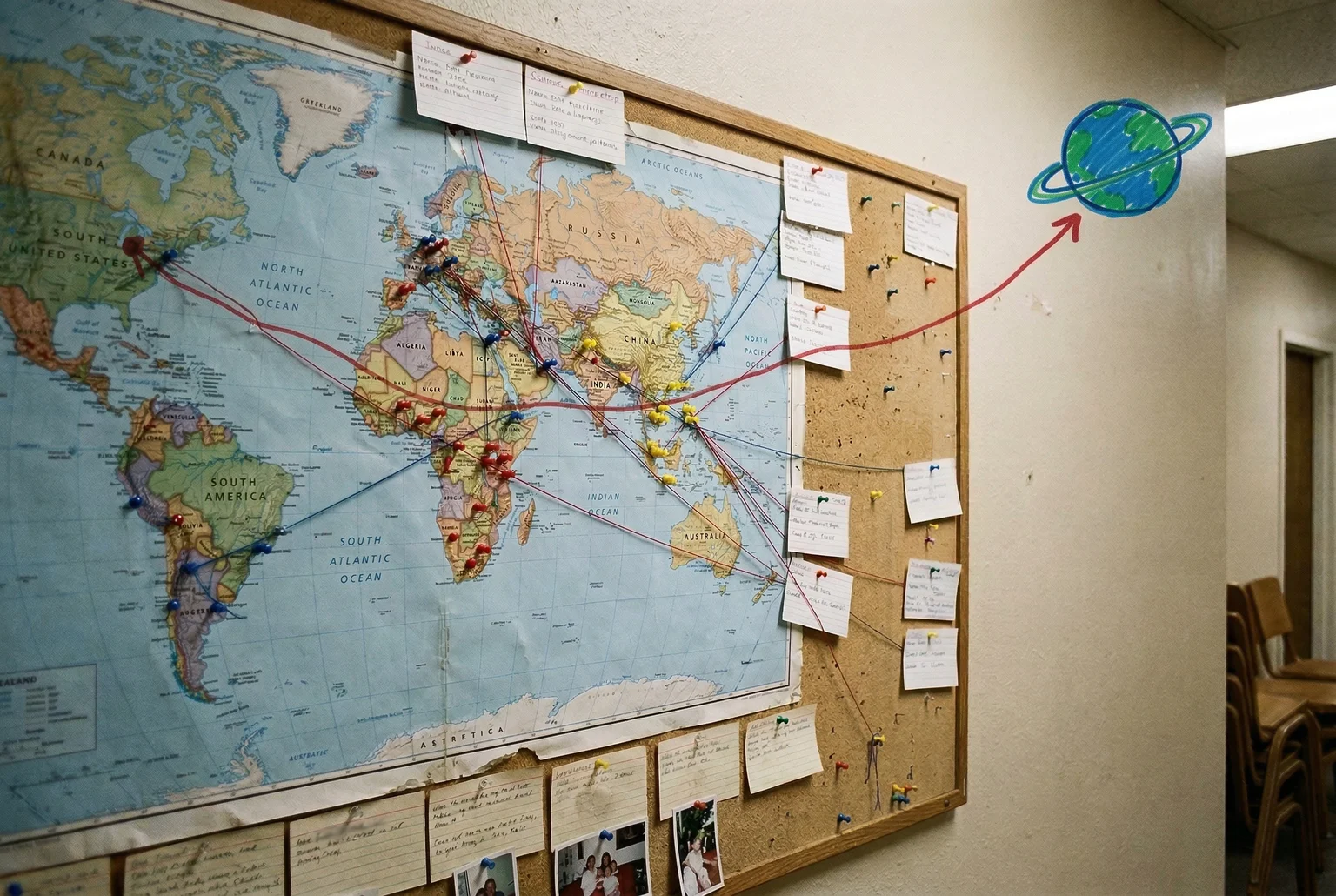
The satirical punchline writes itself, but the underlying theological tension is real: a salvation framework designed for one world has to either expand to cover others, or admit that its scope was always more local than it claimed.
And Catholic theology has a long history of expanding rather than contracting. Heliocentrism was a crisis until it wasn’t. Evolution was a scandal until it wasn’t. The Church tends to move slowly and then suddenly, updating the brochure when the facts get loud enough to ignore. [27] [28] The betting money is probably on a magisterial statement, carefully worded, allowing that God’s salvific will may extend to rational beings across the cosmos in ways not fully revealed to humanity, with further discernment pending. A papal commission. Some very long documents in Latin.
The baptism question, though, is going to need a faster answer. Because if a seven-foot bioluminescent being walks up to a priest in Ohio and says, politely, that it would like to receive the sacrament — Brother Consolmagno already said yes. [38]

The machine is already moving. It just needs the alien to ask.
Islam Is Surprisingly Chill About This (Until You Get to the Logistics)
Islam has a structural advantage over Christianity when it comes to alien contact, and that advantage is baked right into the opening line of the Quran. Alhamdulillahi rabb il-‘alamin — “Praise be to God, Lord of the Worlds.” Plural. Worlds. Not “Lord of Earth.” Not “Lord of the One Place Where Rational Beings Live.” The Quran opens with a scope claim that is, by any reading, cosmically ambitious. [46]

Then there’s Surah 42:29, which many commentators read as a direct statement that God scattered living creatures across the heavens and the earth. [44] [45] The Arabic word daabah, used for those creatures, typically means something that moves: animals, beings, things that walk around and do stuff. [10] There is genuine scholarly debate about exactly what this implies, but the point is that the Quran at least leaves the door open in a way that, say, a text centered entirely on one nation’s covenant with God does not.
So on the question of “could there be alien life,” many Muslim scholars have looked at their source material and said: plausibly yes, God is big enough for this, carry on. Contemporary voices like Yasir Qadhi have argued that Islam’s cosmology can accommodate extraterrestrial beings without threatening the faith’s foundations. [45] [46] The universe being full of other creatures would not, in itself, contradict anything essential.
Here is where it gets complicated.
The Quran also states, clearly, that Muhammad is the Seal of the Prophets — the last prophet, the final revelation, the closing of the line. [56] [57] This is not a footnote. It’s a load-bearing doctrine. And it raises a question nobody in 7th-century Arabia needed to answer: if there are intelligent beings on other worlds, did God just leave them with no guidance? No prophets? No revelation? Or did God send prophets to those worlds — in which case Muhammad being “the last prophet” means the last prophet to humans, specifically, which is a reading that requires some interpretive gymnastics that the classical scholars were not doing at the time. [46]
Some modern thinkers argue that reading is valid; that the finality of prophethood applies to humanity, and that what God does for other beings on other worlds is simply not specified, and that’s fine. [45] Others find that answer a bit too convenient. The honest position is: this is unresolved, it’s a real tension, and the tradition is actively working on it, slowly.
The logistics problem is somehow even better than the theology problem.
When Malaysian astronaut Sheikh Muszaphar Shukor went to the International Space Station in 2007, it was Ramadan. He needed to fast, pray five times a day facing Mecca, and generally maintain Islamic practice while orbiting Earth at 17,500 miles per hour, crossing a sunrise every 90 minutes. [49] [58] Malaysia’s National Fatwa Council issued a 12-page guide covering prayer times, the direction of Mecca, and how to handle fasting when “sunset” happens sixteen times a day. The pragmatic conclusion: do your best, face Earth generally, use your judgment. [50]
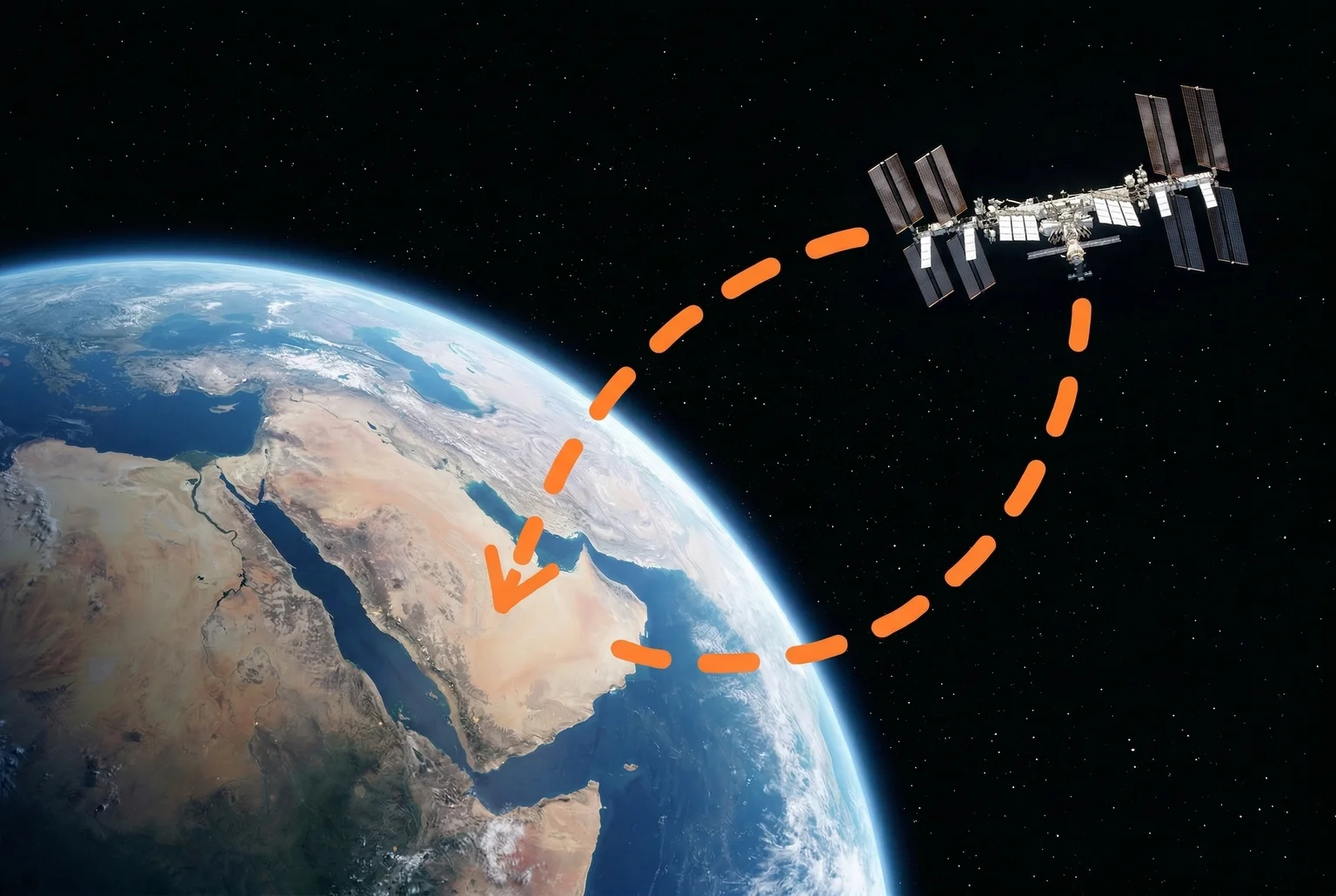
This is actually a beautiful example of how Islamic jurisprudence works — a living legal tradition that encounters new situations and reasons through them, carefully, using existing principles. The fiqh scholars didn’t panic. They sat down, applied the methodology, and produced a ruling. The tradition has adaptive muscles.
Now scale that up. The aliens are not from the ISS. They are from somewhere outside the solar system. The qibla problem in orbit was hard enough: at least you could still point at Earth. From another solar system, pointing toward Mecca becomes an exercise in theoretical physics that would make your head hurt. And if humans who have converted to Islam are traveling to other star systems, or if alien beings are curious about the faith, the jurisprudential questions start stacking up in ways that the fatwa councils will need significantly more than 12 pages to address.
Islam’s instinct is to reason through it. That’s actually reassuring. The tradition has the intellectual tools. It just has a lot of homework ahead of it.
Judaism’s Response: Not Really Our Department
Judaism’s reaction to alien contact would probably be the calmest of any major religion, and the reason is almost funny in its elegance: the whole framework isn’t really designed to apply to anyone else in the first place.
Christianity has a universal salvation mandate: every soul, everywhere, needs saving. Islam has a universal da’wah impulse — the message is for all of creation. Judaism’s covenant is specifically between God and the Jewish people. It’s not a claim that God doesn’t care about everyone else. It’s just that the specific legal and ritual obligations of the Torah — the 613 commandments, the dietary laws, Shabbat, the whole apparatus — are the obligations of Israel. [52] [53] [55] Non-Jews (including, the reasoning would extend, non-Earth beings) operate under a different, lighter framework: the seven Noahide laws, which are basically “don’t murder, don’t steal, set up courts, and a few other basics.” [55]
Aliens would almost certainly fall into the “not our legal problem” category. They didn’t receive the Torah at Sinai. They’re not party to the covenant. A rabbi looking at a seven-foot bioluminescent extraterrestrial would not, theologically speaking, be obligated to hand them a Talmud and get them started on tractate Berakhot. They might, out of interest. But it’s not required.
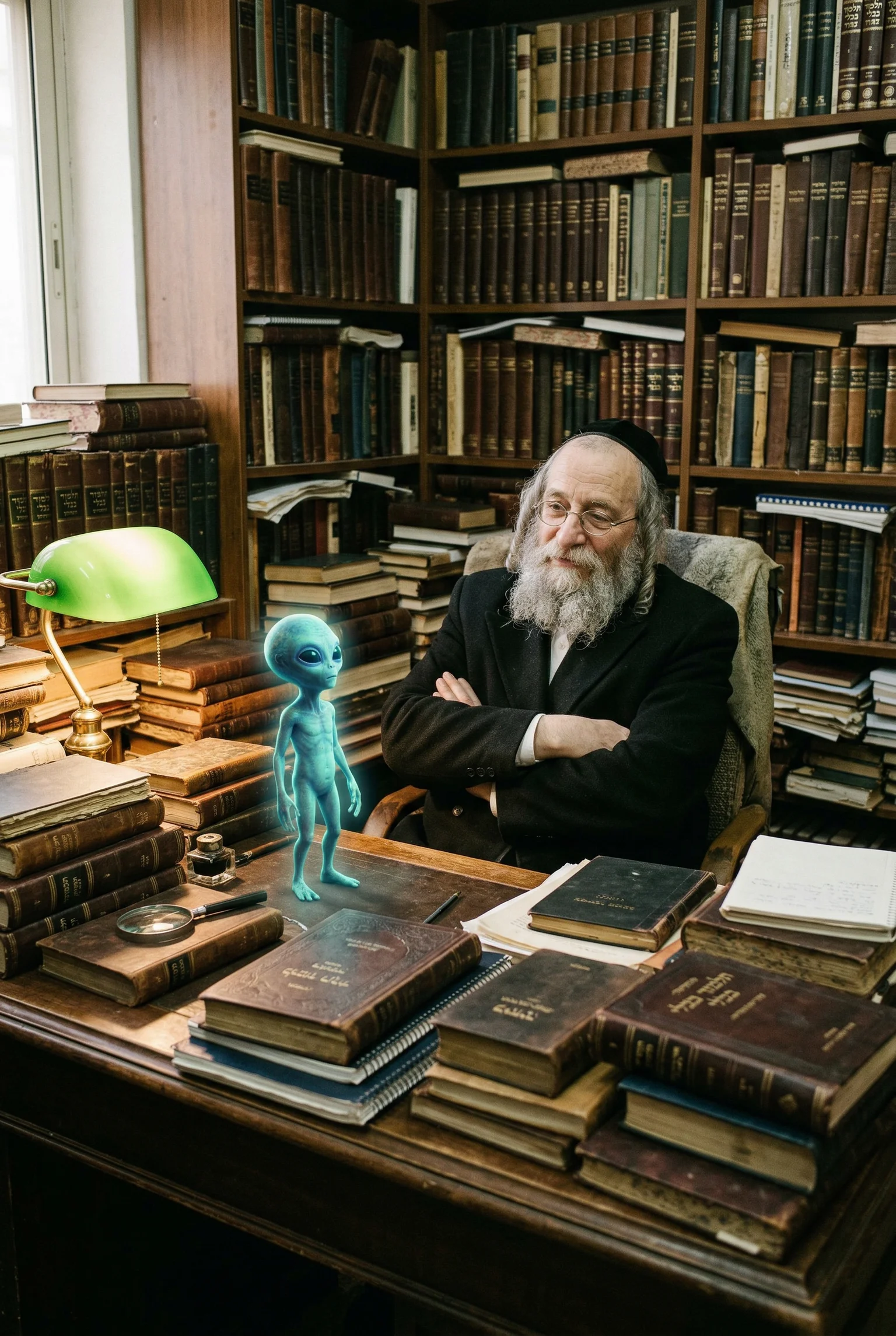
This isn’t dismissiveness, it’s actually a sophisticated theological position. The Jewish tradition has spent millennia being quite clear about what it is and what it isn’t. It is a particular covenant, a particular people, a particular set of obligations. It does not require the universe to revolve around it in the way that universalist traditions do. Alien life arriving would require Christians and Muslims to do significant theological restructuring. Judaism gets to say: interesting, tell us more, but also this doesn’t technically change our situation.
The rabbis have already been arguing about this, because of course they have. The Talmud contains a reference to God creating and destroying multiple worlds before this one, and a separate tradition about 18,000 worlds. [51] [54] Medieval thinker Chasdai Crescas argued that other inhabited worlds were perfectly compatible with Torah. Yosef Albo pushed back, worried that other rational beings would undercut human uniqueness. Later authorities, according to sources that engage this question seriously, mostly came down on Crescas’s side. [52] [53] [54]
The Lubavitcher Rebbe — Menachem Mendel Schneerson, one of the most influential Jewish figures of the 20th century — went further and actively encouraged the scientific search for extraterrestrial life, arguing that denying the possibility “limits what God can do.” [51] [53] That’s a remarkably open position, and it comes from one of the most traditionally observant streams of Judaism.
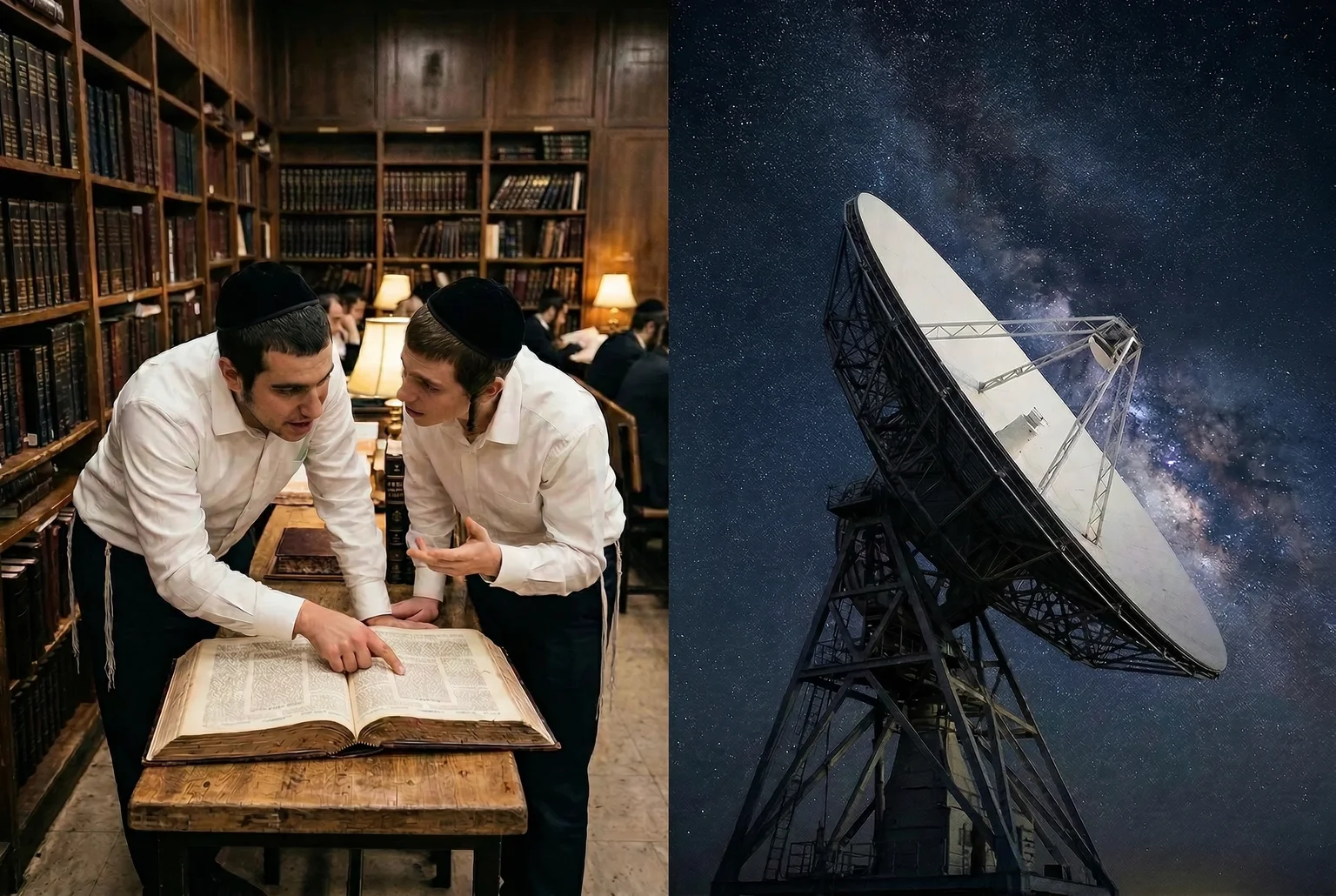
The practical upshot is this: if aliens land, a significant number of rabbis will want to immediately figure out whether the aliens are conscious, whether they have moral agency, and whether they might be subject to Noahide law. Then they will argue about it, vigorously, for several decades, while continuing to observe Shabbat, because Shabbat does not pause for extraterrestrial contact. The disagreements will be recorded in detail. The detail will spawn further disagreements. This is how the tradition works, and it works pretty well.
The Jewish response to alien contact is, in the most genuinely affectionate sense possible: we’ll add it to the list of things we’re already arguing about. The universe got bigger. The argument got more interesting. Kugel on Shabbat is still kugel on Shabbat.
The aliens, meanwhile, will have to figure out whether they even want to be subject to Noahide law. Given that it includes “don’t murder,” probably yes.
Hinduism Already Has 14 Universes
After Christianity’s soul crisis, Islam’s qibla geometry problem, and Judaism’s cheerful shrug, you might be wondering if any major religion genuinely saw this coming. The answer, with remarkable confidence, is Hinduism.
Not metaphorically. Not “with some creative reinterpretation.” Hindu cosmology is, structurally speaking, an alien contact story that’s been running for several thousand years without the aliens needing to show up to make it work.

Start with the basic architecture. Hindu cosmology describes fourteen lokas — distinct realms of existence, seven above the earth and seven below, each populated by different classes of beings. [67] [69] Not humans. Not variations on humans. Devas (celestial beings with capabilities that would make a NASA engineer weep), asuras (their adversaries, equally powerful), nagas (serpentine intelligences), gandharvas, apsaras, rishis who have transcended ordinary human limits entirely. These are not angels in the Christian sense, doing administrative tasks for God. They have societies. Politics. Wars. Grudges that span cosmic cycles. [68]
The word “extraterrestrial” means, literally, beyond Earth. Hinduism has been casually populated with beyond-Earth intelligences since before the Common Era. If you showed a classical Hindu scholar a seven-foot bioluminescent being that arrived in a ship from another star system, the question wouldn’t be can our framework handle this? It would be: which loka are they from, and what’s their karma situation?
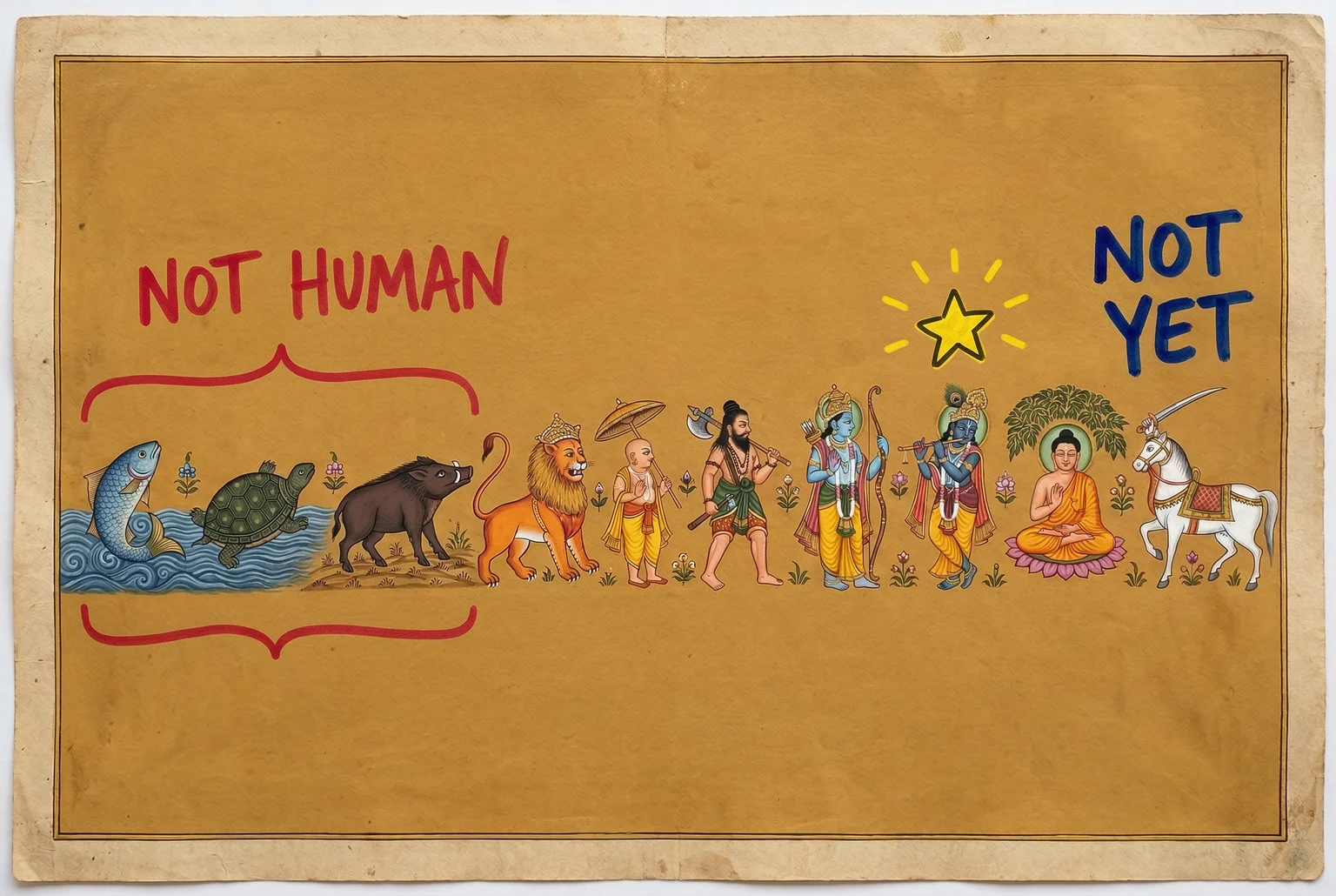
Then there’s the avatar doctrine, which is either the most theologically useful or most theologically terrifying idea on this list depending on your perspective. Vishnu, the Preserver, takes form in the world whenever the cosmic balance tips badly enough. Some of those forms are human. Some are decidedly not: Matsya the fish, Kurma the tortoise, Varaha the boar. [60] The doctrine establishes, at its foundation, that divinity can manifest in non-human, non-terrestrial forms. An alien being that arrives claiming some form of divine expression would not be automatically incompatible with the framework. A Hindu theologian wouldn’t necessarily believe them, but they’d have a conceptual drawer to put the idea in. Every other religion we’ve covered is frantically building that drawer from scratch.
And if the lokas and avatars weren’t enough, the Puranic tradition describes not just multiple worlds but multiple universes, each with its own Brahma, running on timescales that make the Big Bang look like a recent development. [59] [60] Some commentators have compared this to the modern multiverse hypothesis. That comparison is probably doing a lot of work, and you shouldn’t read too much cosmological precision into ancient mythological texts. But the structural instinct — that existence is vast, cyclical, populated, and not arranged primarily for the convenience of one species on one planet — is genuinely baked in there. The universe being full of other intelligent life is not a crisis for Hindu cosmology. It’s practically a confirmation of prior expectations.
This doesn’t mean Hinduism floats serenely above the chaos of first contact. Questions about dharma (right action, right duty) get considerably thornier when the beings you’re interacting with have no caste system, no karma history you can access, and possibly no concept of moksha (liberation from the cycle of rebirth). The ritual and social structures of practiced Hinduism are still very much built around human contexts. But at the level of “can the cosmos contain this?”, Hinduism was already there.
Buddhism Would Just Ask If The Aliens Are Suffering
Buddhism’s response to alien contact is different, and in some ways more interesting, from the other religions because it starts from such a different place.
Buddhism doesn’t require a creator God. It doesn’t have a covenant, a revelation, or a unique chosen people. What it has is a diagnosis: consciousness arises, clings, suffers. The path is to understand and release that process. The entire framework is built around mind and experience, not around the specific biological container those things show up in.
This makes Buddhism weirdly portable.
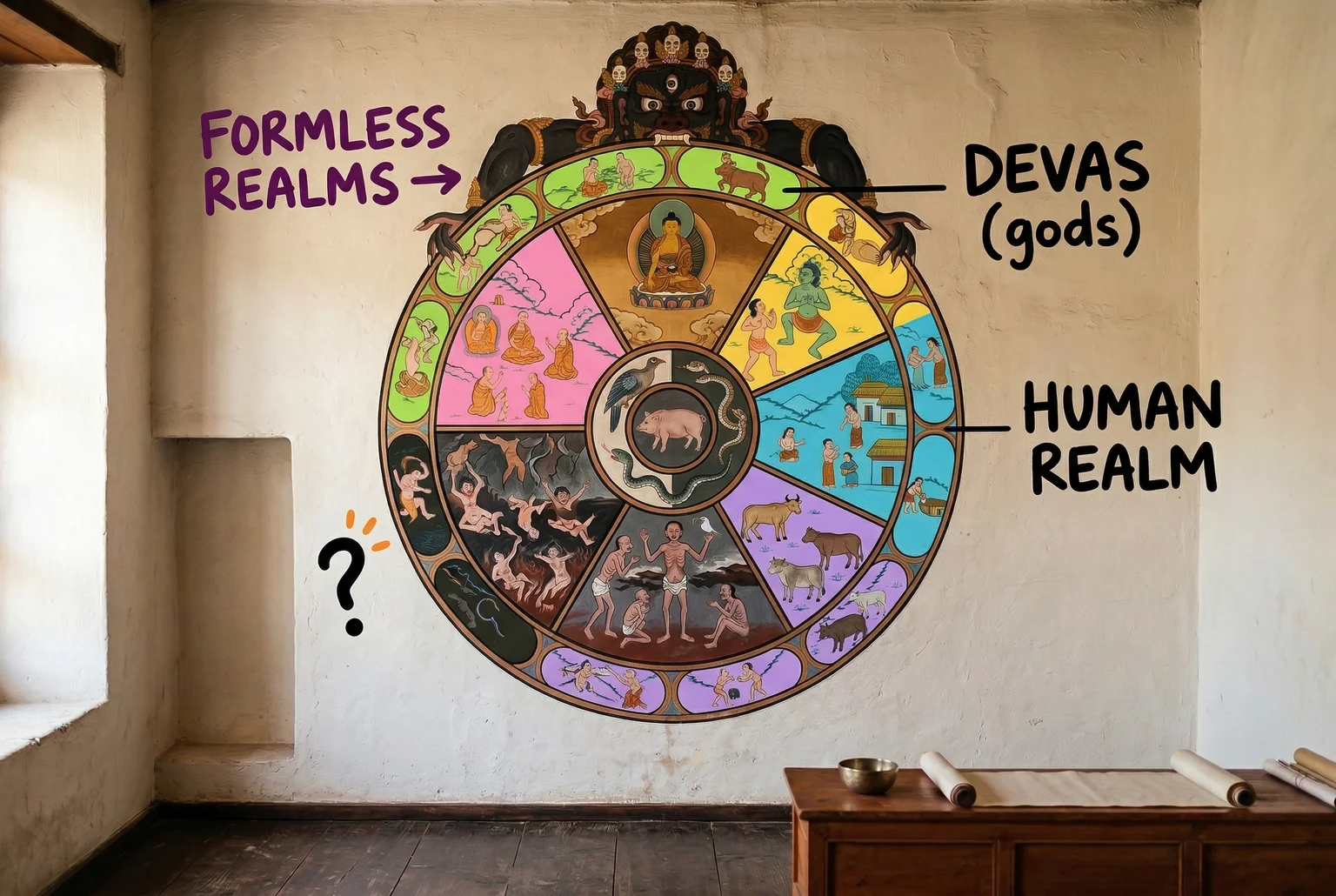
Buddhist cosmology already includes populated multiple world-systems, and each of those worlds can have its own Buddha: an awakened being who has understood the nature of mind and suffering and teaches others to do the same. [62] [65] The canonical texts describe brahma realms, beings of pure form, and “formless” realms where consciousness exists without any physical substrate at all. [62] [65] Whatever the aliens are made of is, in Buddhist terms, largely beside the point. The relevant question is whether they have minds that cling, experience dukkha (suffering), and are capable of awakening to that process.
The Dalai Lama, who has been asked about extraterrestrials on multiple occasions because apparently that’s part of the job, has suggested that beings from other worlds might be capable of spiritual development. [63] The answer is consistent with the logic of the tradition: if there is mind, there is the possibility of liberation. Biology is basically a side conversation.
The doctrine of anatta, or “no fixed self”, means Buddhism was already skeptical of the idea that there’s a permanent, essential human soul to be uniquely threatened by alien existence. And the rebirth cosmology raises a genuinely strange question: could some of the aliens be rebirths of beings who were previously human? Or vice versa? Are some of those arriving spacecraft carrying beings who were, several lifetimes ago, someone’s grandmother? [62] The texts don’t give a tidy answer. But the framework at least allows the question without immediately short-circuiting. [63]
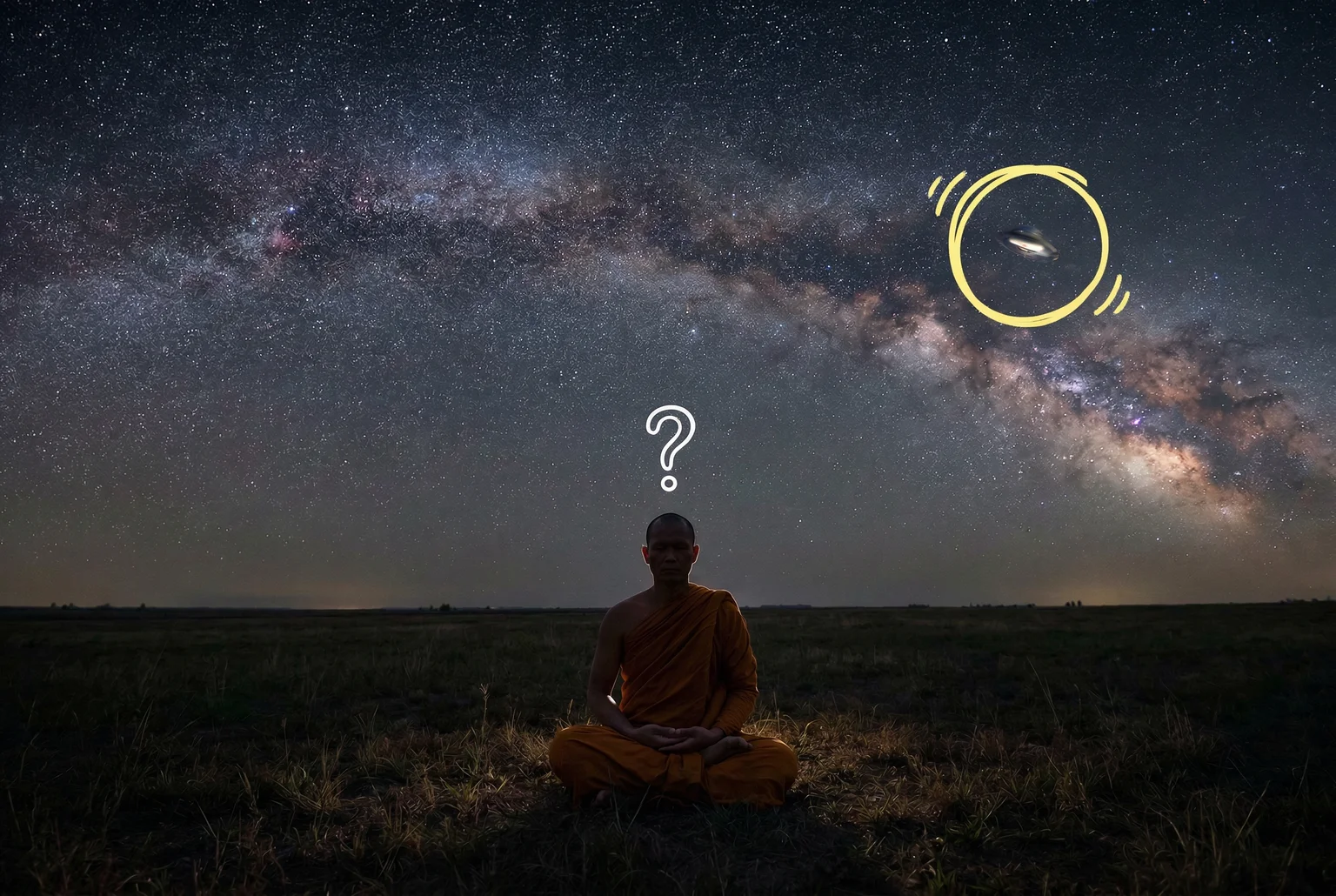
What Buddhism doesn’t have is a cosmological EGO problem. No doctrine of humans as uniquely central, uniquely salvageable, uniquely worthy of divine attention. If the aliens are conscious and suffering, the compassionate response is the same response you’d give a human: try to help them understand the source of that suffering and the path out of it. The Bodhisattva ideal, the commitment to remain engaged with existence until all sentient beings are liberated, doesn’t specify “all human sentient beings.” It just says all of them.
The practical complications are real. Monastic rules, ritual schedules, the specific cultural forms Buddhism has taken across Asia; none of that was designed with non-terrestrial contact in mind. But at the level of first principles, Buddhism’s founding questions — what is mind, what is suffering, what is the path to liberation — are not questions that break under the weight of alien contact. They’re questions that would simply get applied to a new and very interesting case.
If Hinduism’s response to alien contact is “yes, we have a category for that,” Buddhism’s response is something like: “fine, but are they suffering? Because if so, we have work to do.”
The Most Likely Outcome Is A Religion Nobody Has Heard Of Yet
Here’s the thing about all of the above: the Catholic soul-counting, the Islamic geometry problem, the Jewish shrug, Hinduism’s cosmic filing system, Buddhism’s compassionate curiosity; all of it assumes that human beings, when confronted with something genuinely unprecedented, reach for the old frameworks. Some will. Most, probably, for a while.
But history has a pattern, and the pattern is this: when contact with something radically foreign shatters the existing order badly enough, people don’t just adapt their old religions. They build new ones.
After World War Two, allied forces withdrew from several Melanesian islands, taking their supplies, their aircraft, and their inexplicable abundance with them. The islanders who had watched cargo fall from the sky for years responded by building their own runways out of bamboo, constructing wooden headsets, and marching in formation with wooden rifles — ritual imitations of what they’d witnessed, performed in the hope of summoning the cargo back. [75] [77] The John Frum movement on Tanna, Vanuatu, blended these imitation-military rituals with revived traditional practices and a millenarian promise: abundance will return, if the right things are done correctly. [75] [76] [83] Decades later, it persists as a genuine cultural and political force on the island.

The mechanics are always the same. Disruptive contact. Existing frameworks break. Charismatic leader steps into the gap. New system of meaning assembles around the contact event. Rituals emerge that are partly imitation of the powerful outsiders, partly reinvention of something older, and entirely convinced of their own necessity. [77]
This happened with industrialization. It happened with colonialism. It happened, entertainingly, when a French journalist named Claude Vorilhon claimed in 1973 to have met extraterrestrials who told him humanity was genetically engineered by aliens called the Elohim, and that all religious prophets were alien messengers. He renamed himself Raël. The resulting movement, Raëlism, now claims tens of thousands of followers, has its own rituals (including something called the “transmission of the cellular plan,” which is exactly as strange as it sounds), its own embassy project to welcome the Elohim back to Earth, and its own distinctive symbols. [79] [80] This happened before confirmed alien contact. Before a ship. Before anything verifiable at all.
Now imagine the actual ship landed.
Liu Cixin imagined it, and what he wrote in The Three-Body Problem is the most useful template we have for what comes next.
In the novel, a scientist named Ye Wenjie, having lived through the Cultural Revolution and developed a fairly dim view of humanity, makes contact with an alien civilization called the Trisolarans. She doesn’t keep this to herself. She builds a movement: the Earth-Trisolaris Organization (ETO), a global network of humans who, for various reasons, have decided that humanity deserves to be conquered or replaced, and that the Trisolarans are the appropriate instrument. [70] [71] [73]
What makes this fictional cult so instructive is how quickly it fractures. The ETO splits into at least two wings with violently incompatible views. The Adventists think humanity is irredeemably corrupt and actively want alien eradication. The Redemptionists develop something closer to devotion; they view the Trisolaran homeworld as a kind of sacred destination, the aliens themselves as lords whose survival is a moral imperative, and human extinction not as punishment but as necessary sacrifice. [70] [71] [74] They worship, in functional terms, at the altar of a star in Alpha Centauri, and they recruited heavily through an immersive online game that embedded players in Trisolaran history until they came out the other side radicalized. [70] [72] [74]
The video-game-as-conversion-tool detail is, honestly, the most plausible part of the whole book.

Because here’s what an alien-contact religion would almost certainly look like, if we extrapolate the historical pattern forward with honesty:
It starts within a week. Not institutionally. In a Discord server, or whatever Discord has been replaced with by the time this happens. Someone posts a thread. The thread is titled something like “They came here for a reason, and the reason is us.” It gets thirty thousand upvotes in four hours.
The founding text is assembled from whatever information leaks out of the government’s contact protocols, whatever the aliens have communicated (even partially, even badly translated), and a significant amount of creative interpretation by someone who was already spiritually dissatisfied and has now found their occasion. Then they ask ChatGPT to write the first draft. The core doctrine: the aliens are not visitors. They are a judgment, or a invitation, or a mirror. Depending on the faction.
Because there are factions immediately. There are ALWAYS factions immediately. The Preparationists believe humanity must spiritually purify itself before the aliens will share their knowledge. The Surrenderists believe resistance is the sin. A smaller, quieter group called something like the Listeners believe the aliens have already been communicating with select humans for decades through means we haven’t recognized yet — Listeners have a subreddit and a podcast and they are absolutely certain your sleep paralysis was not a coincidence.
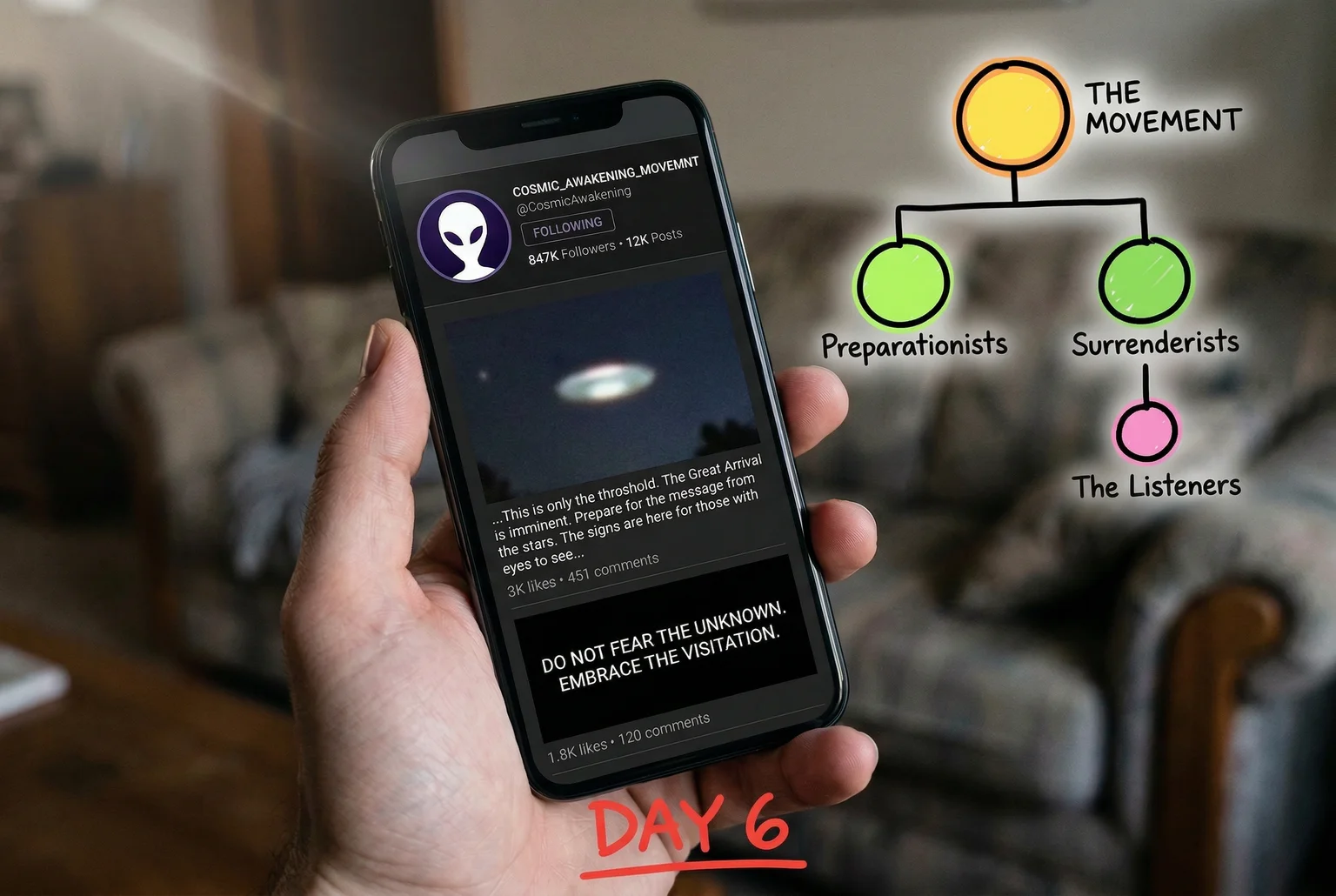
The rituals arrive fast, because humans are ritual-making machines who cannot help themselves. There is a posture for the direction of the ship (facing away from the sun at dawn, probably, because someone will decide the geometry matters). There is a silence observed at whatever hour the ship first appeared on radar. There are dietary restrictions derived from speculation about what the aliens eat, because of course there are. There is a debate about whether the aliens should be referred to by the designation in the official government report, or by the name a seventeen-year-old in São Paulo gave them in a viral post that felt, somehow, more right.
The first major schism happens over whether the contact was a gift or a warning. The second happens over money. They always happen over money.
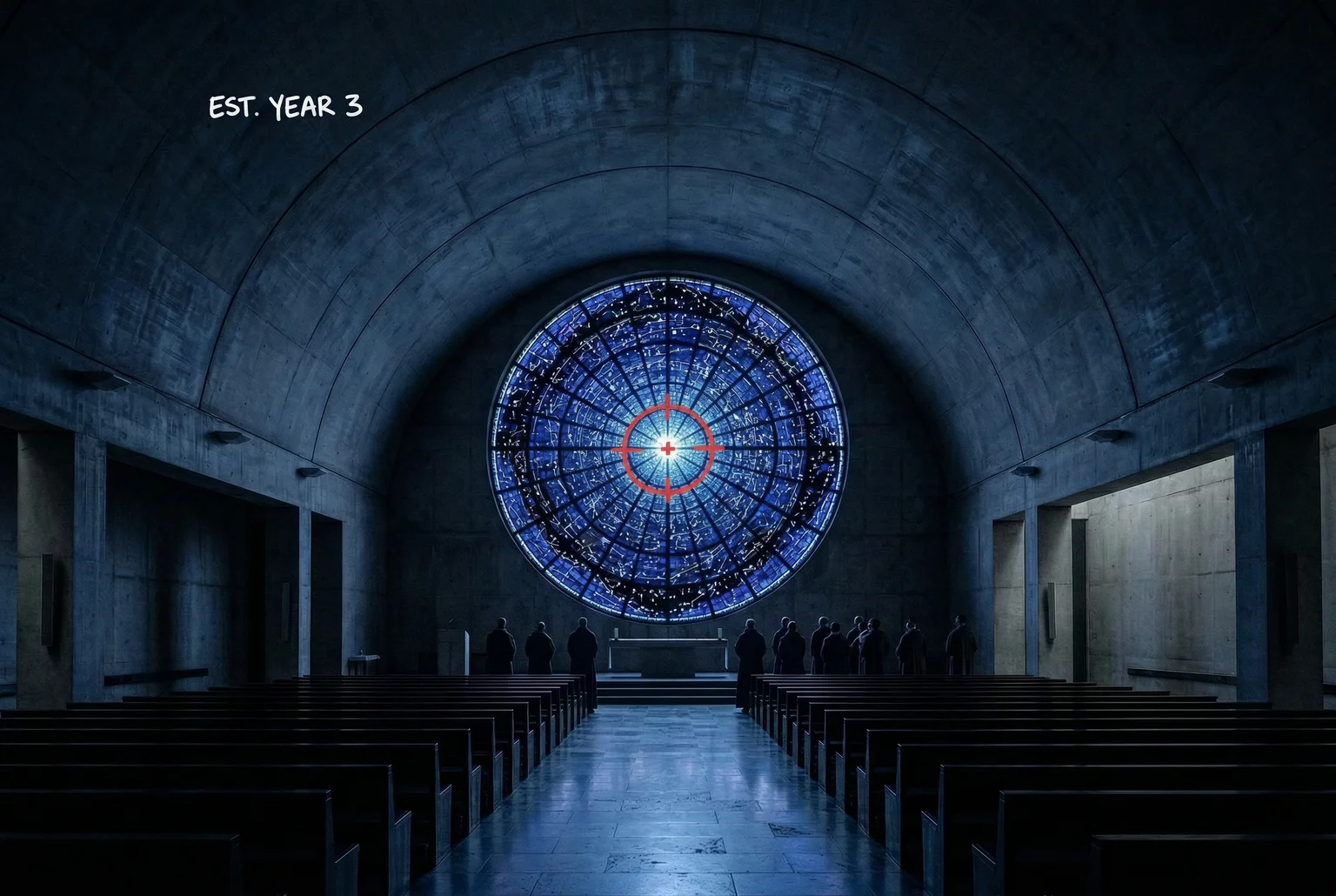
By year three, there are temples. Not metaphorical temples. Buildings. Architecture designed to face the coordinates where the ship first appeared. Stained glass depicting the approach trajectory. Choirs developing music in frequencies speculated to resemble alien communication: pure vibration, unresolvable into melody, which the faithful find transcendent and which everyone else finds deeply unpleasant at any volume.
By year ten, there are children who have grown up inside this. For whom the ship is not an event but a fact of the world, like weather, like gravity. And those children will ask the same questions children always ask: why are we here, what does it mean, what should I do? The new religion will answer them. It won’t answer correctly, necessarily. It will answer with the particular confident warmth that religions generate when they have decided the question is settled.
Scholars will study it. Governments will be unsure whether to regulate it. The older religions will be dismissive at first, then threatened, then quietly incorporating its language into their own frameworks, the way every generation of religion absorbs the one it’s trying to distinguish itself from.
And somewhere, a long time from now, a historian will write a chapter about the first weeks after contact: when the existing faiths scrambled to adapt, when the theological journals filled with emergency position papers, when the Pope and the Grand Mufti and the Chief Rabbis and the Shankaracharyas all issued careful statements. The historian will note, with the gentle condescension only historians can muster, that the real religious story of first contact wasn’t any of that. It was the Discord server. It was the São Paulo teenager. It was the temple facing the sky.
It was, as it always has been, the people who needed a new story badly enough to write one.
The question worth sitting with isn’t whether that will happen. It’s whether, when it does, you’ll be the person rolling your eyes at it from the outside, or the person who, quietly, finds themselves listening.
Sources
[1] What Writers Learn From Andy Weir — https://www.hiddengemsbooks.com/what-writers-learn-from-andy-weir/
[2] YouTube video analysis of Andy Weir (video) — https://www.youtube.com/watch?v=8RGQNTCY-nY
[3] Review: Andy Weir — Project Hail Mary (2021) — https://jeroenthoughts.wordpress.com/2021/05/26/review-andy-weir-project-hail-mary-2021/
[4] Project Hail Mary — book review — https://www.washingtonindependentreviewofbooks.com/bookreview/project-hail-mary
[5] 3 Things I Learned About Writing by Analyzing Andy Weir’s The Martian — https://www.writersdigest.com/whats-new/3-things-i-learned-about-writing-analyzing-andy-weirs-the-martian
[6] “it is kind of insane how covid just completely fucking ruined everything lol” (tweet) — https://x.com/i/status/1918370593453555935
[7] Satire on CDC firings after COVID (tweet) — https://x.com/i/status/1961110209692131489
[8] Pun: Israel and Iran don’t have Walmarts, only Targets (tweet + video) — https://x.com/i/status/2028405354045043042
[9] Mocking Khamenei’s death (tweet) — https://x.com/i/status/2027929706033492185
[10] Satire about US ‘preemptive’ Iran strike (tweet) — https://x.com/i/status/2028733657285083633
[11] Iron Dome OPSEC fail video (tweet) — https://x.com/i/status/2028073202287604105
[12] Astronaut lands on alien planet; locals rename pub ‘The Keyboard’ -> ‘space bar’ (tweet) — https://x.com/i/status/2022073863794823504
[13] Alternate post of ‘The Keyboard’ / ‘space bar’ joke (tweet) — https://x.com/i/status/1987944526141370619
[14] Abducted by aliens forced to do chores — ‘mothership parenting’ (tweet) — https://x.com/i/status/1971952217369268532
[15] Aliens skip Earth due to 1-star Yelp reviews (tweet) — https://x.com/i/status/2030434373959287194
[16] How Will Our Religions Handle the Discovery of Alien Life? — https://nautil.us/how-will-our-religions-handle-the-discovery-of-alien-life-236260
[17] Will religion survive alien contact? — https://www.supercluster.com/editorial/will-religion-survive-alien-contact
[18] UFO religion — Wikipedia — https://en.wikipedia.org/wiki/UFO_religion
[19] What Can Catholic Theology Say About Extraterrestrials? — https://churchlifejournal.nd.edu/articles/what-can-catholic-theology-say-about-extraterrestrials/
[20] Theological Studies (PDF) — article (PDF) — https://theologicalstudies.net/wp-content/uploads/2022/08/60.1.1.pdf
[21] NASA hires theologians to prepare humanity for alien contact — https://www.dazeddigital.com/science-tech/article/55157/1/nasa-hires-theologians-to-prepare-humanity-for-alien-contact-priest-space
[22] YouTube video (source referenced in section) — https://www.youtube.com/watch?v=0OHmxmrjJF4
[23] Searching for Our Place in Creation — https://www.vaticanobservatory.org/sacred-space-astronomy/searching-for-our-place-in-creation/
[24] Angels or Aliens? Some Researchers Say Vatican Archives Hold UFO ‘Secrets’ — https://www.usccb.org/news/2024/angels-or-aliens-some-researchers-say-vatican-archives-hold-ufo-secrets
[25] Vatican astronomer: If aliens exist they may not need redemption — https://www.archbalt.org/vatican-astronomer-says-if-aliens-exist-they-may-not-need-redemption/?print=print
[26] Pope Francis on aliens — https://www.thecatholicthing.org/2023/07/06/pope-francis-on-aliens/
[27] Science and the Catholic Church — Wikipedia — https://en.wikipedia.org/wiki/Science_and_the_Catholic_Church
[28] A Very Brief History of Christians in Science — https://biologos.org/articles/a-very-brief-history-of-christians-in-science
[29] Why astrobiology and the search for extraterrestrial life are important philosophically — https://www.zacharyfruhling.com/philosophy-blog/why-astrobiology-and-the-search-for-extraterrestrial-life-are-important-philosophically
[30] Aliens and the Person of Christ (Or: Whether Aliens Can Be Saved) — https://johnwesleyfellows.org/conversations/aliens-and-the-person-of-christ-or-whether-aliens-can-be-saved/
[31] Would the existence of space aliens threaten Christianity? — https://religionunplugged.com/news/would-the-existence-of-space-aliens-threaten-christianity
[32] What Would Aliens Mean for Christianity? — https://cerebralfaith.net/what-would-aliens-mean-for-christian/
[33] Alien Life and Christian Theology — https://jwwartick.com/2012/08/20/alien-life/
[34] Would aliens be saved? (GotQuestions.org) — https://www.gotquestions.org/aliens-Christian.html
[35] What C.S. Lewis Thought About Aliens — https://www.1517.org/articles/what-cs-lewis-thought-about-aliens
[36] C.S. Lewis Thought Aliens… (article) — https://www.jonathanmerritt.com/article/c-s-lewis-thought-aliens
[37] C.S. Lewis warned us about close encounters of evangelical kinds — https://www.christianitytoday.com/2023/06/cs-lewis-warned-us-about-close-encounters-of-evangelical-ki/
[38] St. Augustine and ‘Baptizing an Extraterrestrial’ (Vatican Observatory) — https://www.vaticanobservatory.org/sacred-space-astronomy/st-augustine-and-baptizing-an-extraterrestrial/
[39] Vatican astronomer would baptise aliens — https://premierchristian.news/en/news/article/vatican-astronomer-would-baptise-aliens
[40] For Pope Francis, It’s About More Than Martians — https://time.com/99616/for-pope-francis-its-about-more-than-martians/
[41] Vatican Official Would Baptize Aliens — https://www.themonastery.org/blog/vatican-official-would-baptize-aliens
[42] The Pope on baptizing aliens (forum thread) — https://puritanboard.com/threads/the-pope-on-baptizing-aliens.83275/
[43] What is Missional Theology? 5 Aspects of a Mission-Centered Approach — https://abwe.org/blog/what-missional-theology-5-aspects-mission-centered-approach-god-and-life/
[44] Quran Aur Aliens (Scribd document) — https://www.scribd.com/document/505412001/Quran-Aur-Aliens
[45] What Does Islam Say About Aliens? A Look at Quranic Verses and Hadith — Part 2 — https://communityonfriday.net/what-does-islam-say-about-aliens-a-look-at-quranic-verses-and-hadith-part-2/
[46] What Does Islam Say About Aliens? A Look at Quranic Verses and Hadith — https://themuslimvibe.com/faith-islam/what-does-islam-say-about-aliens-a-look-at-quranic-verses-and-hadith
[47] Quranic Allusions to Extraterrestrials (Lamp of Islam blog) — https://lampofislam.wordpress.com/2025/12/02/quranic-allusions-to-extraterrestrials/
[48] YouTube: (video cited in section) — https://www.youtube.com/watch?v=d7dRqDAKubM
[49] A scholarly article / guideline (PDF) — Almarshad (UMSU journal) — https://jurnal.umsu.ac.id/index.php/almarshad/article/download/17036/10559
[50] E-IR PDF on religion & space / practice (PDF) — https://www.e-ir.info/pdf/101426
[51] A Jewish Take on the Search for Extraterrestrial Life — https://sinaiandsynapses.org/content/a-jewish-take-on-the-search-for-extraterrestrial-life/
[52] Judaism and Life on Other Planets — https://aish.com/judaism-and-life-on-other-planets/
[53] Is There Life on Other Planets? (Chabad.org) — https://www.chabad.org/library/article_cdo/aid/3012/jewish/Is-There-Life-on-Other-Planets.htm
[54] Hakirah Journal — Article on extraterrestrials & Jewish thought (PDF) — https://hakirah.org/vol27Roth.pdf
[55] The Religious Implications of Extraterrestrial Life — https://traditiononline.org/the-religious-implications-of-extraterrestrial-life/
[56] Where Are They All? The Quran Did Prophesy Them (thequran.love) — https://thequran.love/2024/12/11/where-are-they-all-those-aliens-the-quran-did-prophesize-them/
[57] Islam on Extraterrestrial Life (Islamicity) — https://www.islamicity.org/68874/islam-on-extraterrestrial-life/
[58] A Muslim Astronaut’s Dilemma: How to Face the Qibla from Space — https://theislamicworkplace.com/2007/10/02/a-muslim-astronauts-dilemma-how-to-face-the-qibla-from-space/
[59] IJNRD paper (PDF) — https://www.ijnrd.org/papers/IJNRD2408159.pdf
[60] The Parallel Universe Theory in Hindu Cosmology — https://www.hinduamerican.org/blog/the-parallel-universe-theory-in-hindu-cosmology/
[61] YouTube video (vlZRosnMNeo) — https://www.youtube.com/watch?v=vlZRosnMNeo
[62] Buddhism and the UFO Phenomenon (blog post) — https://palisuttas.com/2016/05/14/buddhism-and-the-ufo-phenomenon-r/
[63] The Dalai Lama Explains What Extraterrestrial Bodies Look Like — https://www.tsemrinpoche.com/tsem-tulku-rinpoche/current-affairs/the-dalai-lama-explains-what-extraterrestrial-bodies-look-like.html
[64] YouTube video (eLvNFS1VCNU) — https://www.youtube.com/watch?v=eLvNFS1VCNU
[65] Are There Buddhas on Other Planets? Imagining Extraterrestrial Spiritualities — https://www.openhorizons.org/are-there-buddhas-on-other-planets-imagining-extraterrestrial-spiritualities.html
[66] Fourteen Worlds (Bhu-mandala) — description of the 14 lokas — https://www.iskcon-truth.com/bhu-mandala/fourteen-worlds.html
[67] Lokas — Planets of Advanced Aliens? (blog) — http://decodehindumythology.blogspot.com/2012/04/lokas-planets-of-advanced-aliens.html
[68] YouTube video (puDn2_ebVaE) — https://www.youtube.com/watch?v=puDn2_ebVaE
[69] Vedic Cosmology: What the 14 Lokas of the Brahmand Teach Us — https://www.sanatangyan.com/post/vedic-cosmology-what-the-14-lokas-of-the-brahmand-teach-us-about-life-karma-the-universe
[70] Chapter 29: The Earth–Trisolaris Movement — https://www.litcharts.com/lit/the-three-body-problem/chapter-29-the-earth-trisolaris-movement
[71] The Three-Body Problem (novel) — Wikipedia — [https://en.wikipedia.org/wiki/The_Three-Body\_Problem\_(novel](https://en.wikipedia.org/wiki/The*Three-Body_Problem*(novel))
[72] Three Body (review/post) — The Little Man Reviews — https://thelittlemanreviews.com/2025/04/22/three-body/
[73] Desperately Seeking Global Community Through Film: Cixin Liu’s The Three-Body Problem — https://anunexpectedjournal.com/desperately-seeking-global-community-through-film-cixin-lius-the-three-body-problem/
[74] Review: The Three-Body Problem and religion — https://www.americamagazine.org/arts-culture/2024/04/19/review-three-body-problem-religion-247757/
[75] Cargo cult — Encyclopedia Britannica — https://www.britannica.com/topic/cargo-cult
[76] Cargo Cults and Their Rituals — Sapiens — https://www.sapiens.org/culture/cargo-cult-rituals/
[77] Cargo cult — Wikipedia — https://en.wikipedia.org/wiki/Cargo_cult
[78] Cargo-cults — Anthropology Encyclopedia (entry) — https://www.anthroencyclopedia.com/entry/cargo-cults
[79] Raëlism — Wikipedia — https://en.wikipedia.org/wiki/Ra%C3%ABlism
[80] Factsheet: The Raelian Movement — https://religionmediacentre.org.uk/factsheets/factsheet-the-raelian-movement/
[81] Document on Raëlian beliefs and practices (PDF) — https://www.equip.org/PDF/DD807.pdf
[82] Heaven’s Gate (religious group) — Wikipedia — [https://en.wikipedia.org/wiki/Heaven%27s\_Gate\_(religious_group](https://en.wikipedia.org/wiki/Heaven%27s*Gate*(religious_group))
[83] The Cults That Worship Cargo — Amusing Planet — https://www.amusingplanet.com/2022/06/the-cults-that-worship-cargo.html
[84] Raelian movement teaching document (course material) — https://www.uvm.edu/~lkaelber/teaching/Raelian.docx
If you read this far, you'll like what's next.
One essay a month, roughly. No noise, no sponsored content, no threads.