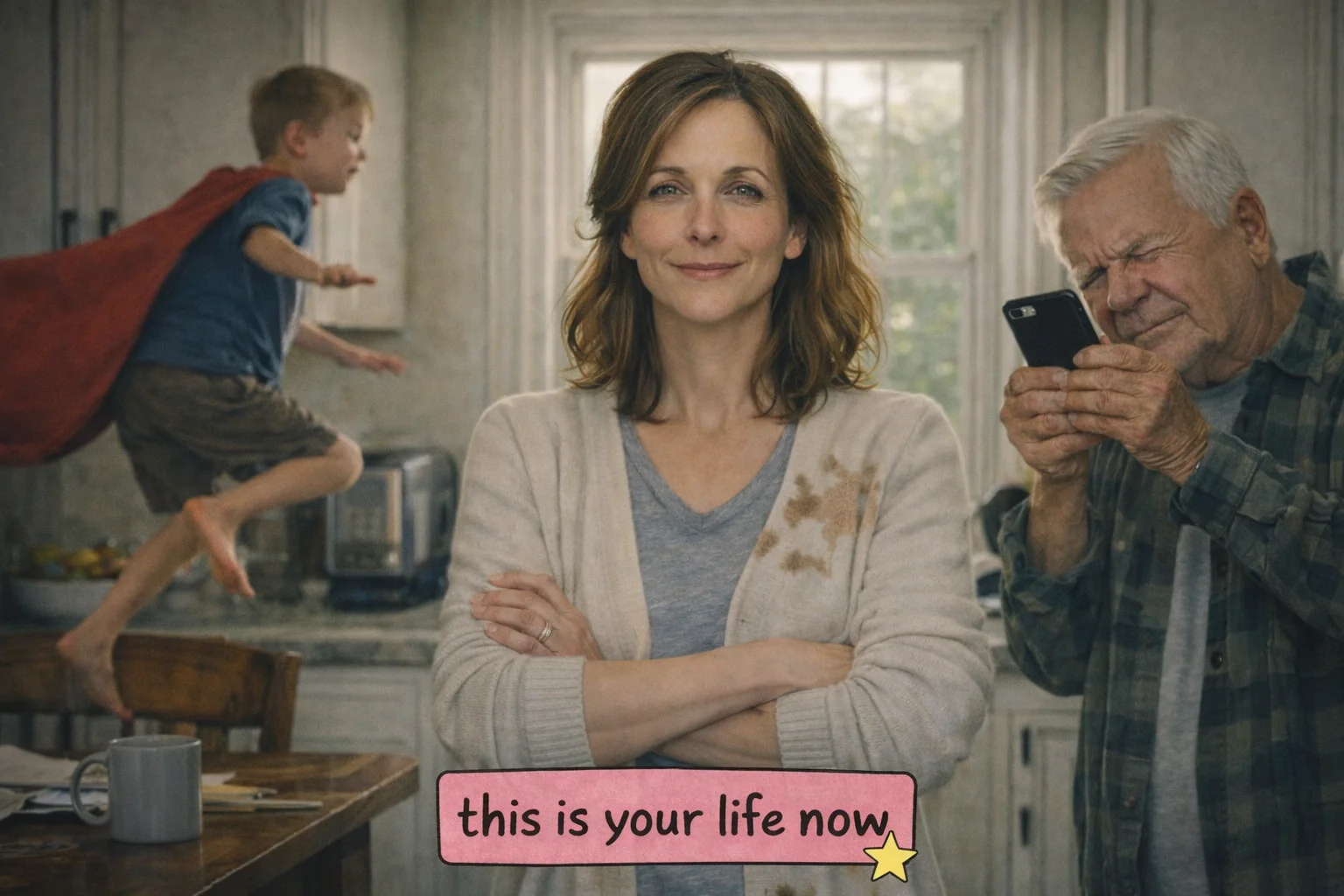
The Inverted U of Common Sense
🎙 Listen to the audio version
The conversation that made you question everything you thought you knew about patience
Picture this. You’re standing in a kitchen, or a living room, or a parking lot, it doesn’t matter, and you’re watching someone you love make a decision so spectacularly bad that you have to physically stop yourself from saying what is WRONG with you.
They wanted something. They were told no. They were given a perfectly reasonable explanation for why no. They appeared to process this information. And then they did the thing anyway, with complete confidence, zero apparent awareness of consequences, and an expression on their face that suggested the laws of cause and effect simply did not apply to them.
You cleaned it up. You said nothing. You went to bed that night and stared at the ceiling wondering if you were losing your mind, or if they were, or if this is just what love costs.
 The mess is cleaned up. Mostly. The ‘why’ is still being processed.
Now picture a second scene. Different day. Different person. You’re watching someone you love make a decision so spectacularly bad that you have to physically stop yourself from saying what is WRONG with you.
They wanted something. They were told no. They were given a perfectly reasonable explanation for why no. They appeared to process this information. And then they did the thing anyway, with complete confidence, zero apparent awareness of consequences, and an expression on their face that suggested the laws of cause and effect simply did not apply to them.
You cleaned it up. You said nothing. You went to bed that night and stared at the ceiling.
 The ceiling has no answers. You checked. Thoroughly.
Here’s the reveal, and you already knew it was coming: one of those people is four years old. The other is seventy-three. And the exhausted adult standing in the middle, cleaning up after both of them, doing the emotional math on whether it’s okay to feel this frustrated, wondering if there’s something wrong with them for finding this so hard?
That’s you. That’s this whole post. Welcome.
What you are living through has a name, or at least it deserves one. I call it the Inverted U of Common Sense. Imagine a curve that starts low on the left, rises to a peak somewhere in the middle, and then comes back down on the right. The left side is childhood. The right side is old age. The peak, that glorious, briefly-held summit of full executive function, processing speed, working memory, and impulse control all firing together at once, is roughly where you are right now.
Which means you are, at this exact moment in your life, the most neurologically capable person in your family or household. You are the apex. You are also, not coincidentally, the only one who seems to understand that you cannot eat candy for dinner, that the stove is hot, that the scam caller is not actually from the IRS, and that clicking “download” on that email attachment is a bad idea.
You are the peak of the common sense curve, and you are being pulled in both directions simultaneously.
The Inverted U of Common Sense
Here is a graph that no psychology textbook has printed yet, but should have.
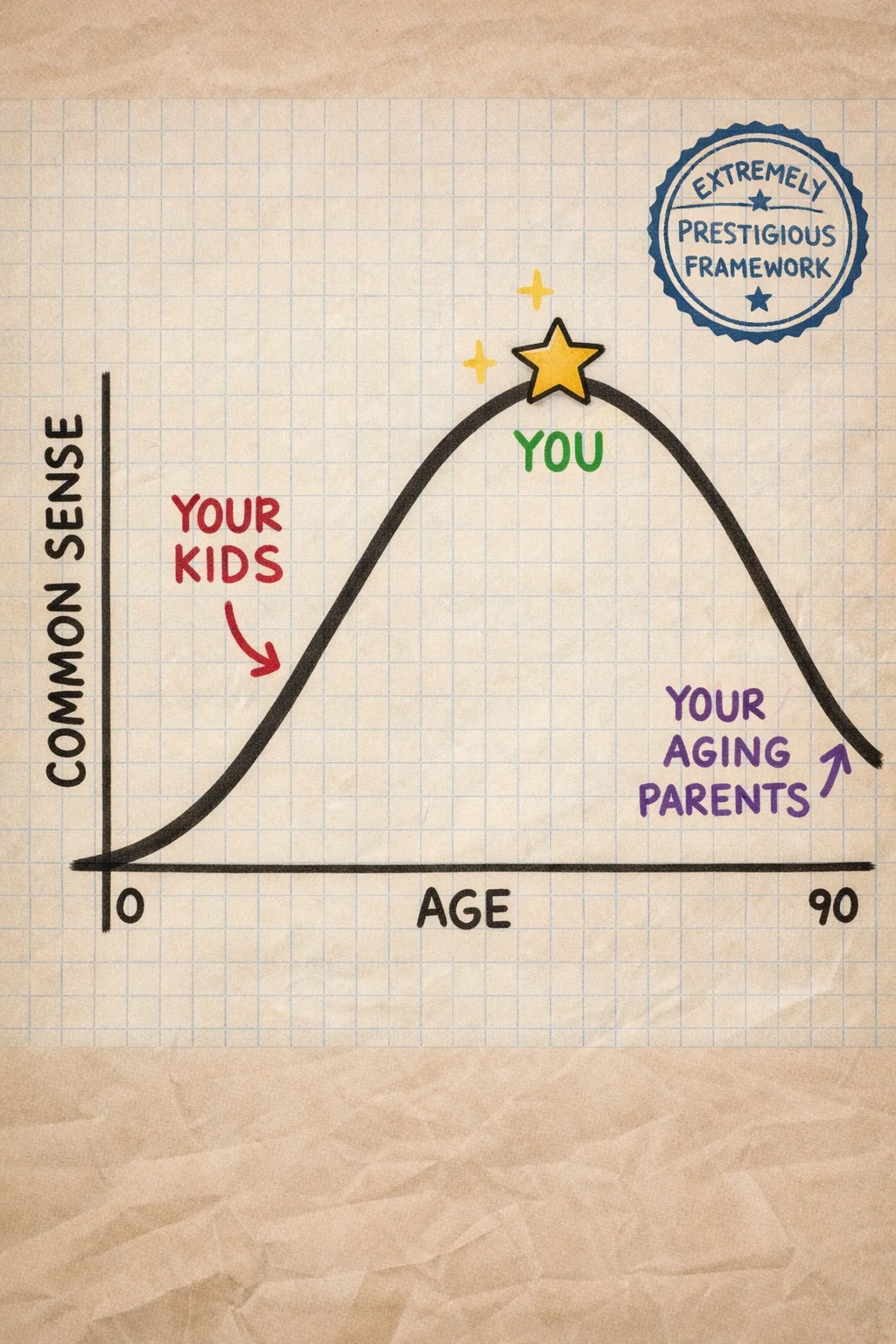 The curve is real. Your position on it is both a privilege and a problem.
The x-axis is age, zero to ninety. The y-axis is something we might loosely call “common sense” — the aggregate of impulse control, risk assessment, working memory, and the basic ability to not do something catastrophically stupid for no reason. The curve rises steeply through childhood and adolescence, crests somewhere in the middle, and then slopes back down on the other side. It is a perfect, symmetrical, devastating arc.
The left slope is childhood. The right slope is old age. The peak — the brief, glorious, sun-drenched summit — is roughly where you are standing right now.
What the left slope actually is
The prefrontal cortex, which handles planning, impulse control, and the general project of not running into traffic, reaches broad structural maturity around age 25 on average, with some regions continuing to refine into the 30s and 40s. [5] [7] This is not a metaphor. The wiring is literally incomplete. Myelination of the medial and orbital frontal regions — the parts most responsible for weighing consequences — continues well past adolescence. [6]
Meanwhile, fluid intelligence, the raw cognitive horsepower for solving new problems and holding information in mind, peaks somewhere in the mid-to-late 20s and then begins a slow, measurable decline. [3] Processing speed peaks even earlier, around 18 or 19 by some large-sample estimates. [13] The child is not being irrational. The child is operating the best hardware they currently have, which is a 1998 desktop running Windows 95.
What the right slope actually is
The right slope is quieter, which almost makes it worse. Processing speed slows. Working memory — the mental scratchpad that holds information while you use it — shrinks. Executive function, the conductor of the cognitive orchestra, starts losing its grip on the brass section. [9] [12] These are not signs of failure. They are the predictable, documented, population-level trajectory of a brain that has been running for several decades.
Crystallized intelligence — accumulated knowledge, vocabulary, pattern recognition built from a lifetime of experience — holds up much better, often improving into the 60s before eventually plateauing. [1] [6] This is why your father can still beat you at Trivial Pursuit while simultaneously being unable to operate the television remote he has owned for four years.
 Two ends of the curve, one shared expression: the thousand-yard stare of a brain at its limits.
The summit
You, at 35 or 38 or 41, are at peak fluid intelligence, near-peak executive function, and accumulating crystallized intelligence by the day. [4] [9] Your prefrontal cortex is as online as it is ever going to be. Your processing speed has not yet fallen off a cliff. You are, neurologically speaking, the most competent person in your household by a margin that is both measurable and, frankly, a little lonely.
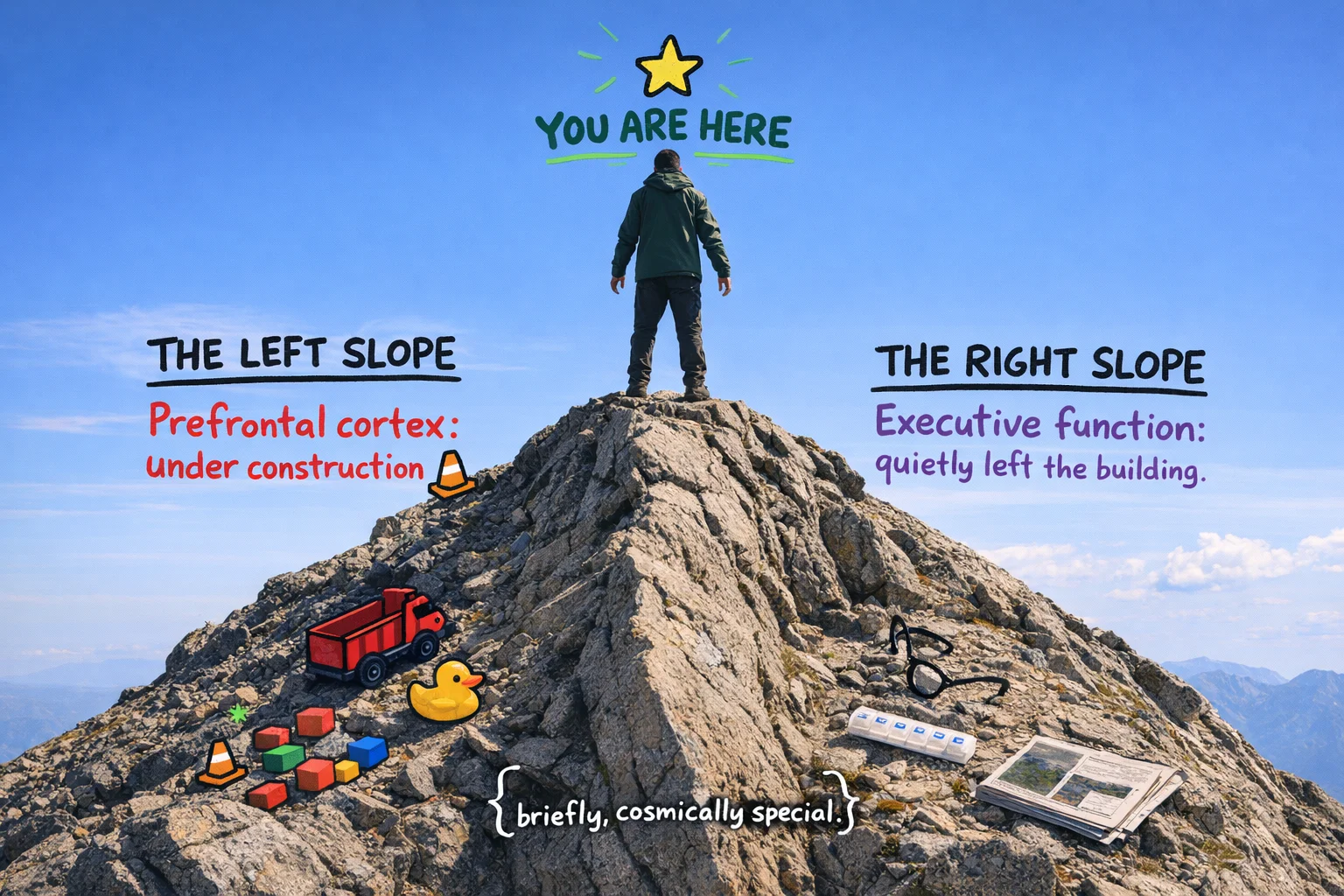 You didn’t climb here. Life just put you here — and now you can see everything.
Which is exactly why you are the one managing everyone else. You didn’t volunteer for this. Life put you here.
Your 4-year-old is not broken. Their brain just hasn’t installed the brakes yet.
Picture someone who spots a dandelion on the other side of a busy road and simply goes for it. No hesitation, no traffic check, no internal monologue weighing the pros and cons. Just pure, unfiltered want-to-have-it energy translated directly into forward motion.
Now picture someone who, when asked “why did you do that,” genuinely cannot tell you. Not because they’re being difficult. Because the part of the brain that would generate that answer doesn’t really exist yet.
That’s your kid. And it is not your fault.
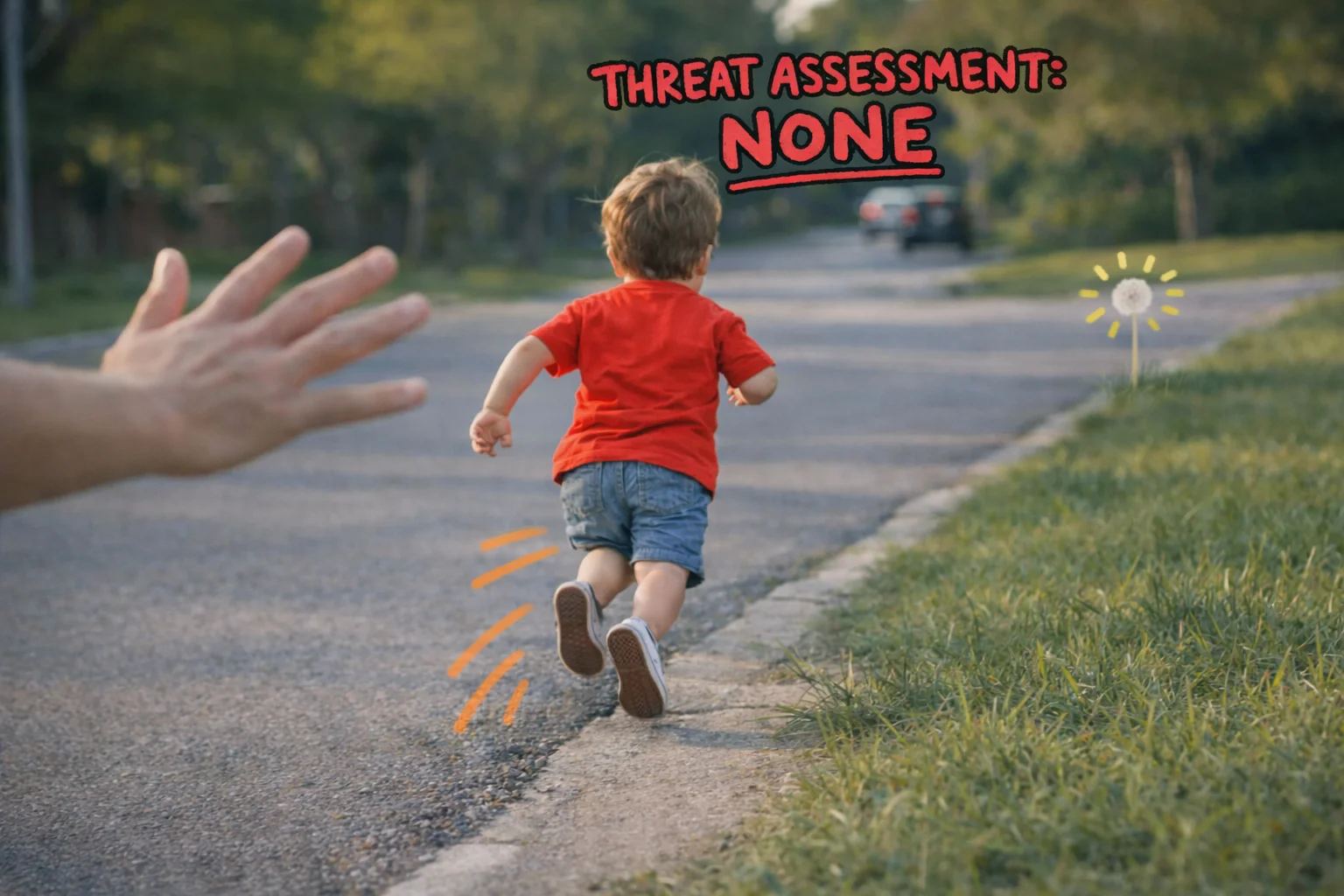 Zero hesitation. Zero traffic check. One dandelion. Full send.
Here’s the neuroscience, delivered as quickly as possible so you can get back to preventing the next incident. The prefrontal cortex (PFC) is the brain’s executive suite: impulse control, risk assessment, long-term planning, the ability to think “actually, maybe I shouldn’t.” It is also, spectacularly, the LAST major brain region to fully mature. We’re talking mid-twenties. [16] Meanwhile, your child’s brain reaches roughly 90% of its adult SIZE by around age six, which means it looks almost done from the outside while being functionally a construction site where the foreman hasn’t shown up yet. [16] [17]
What IS fully online and raring to go? The limbic system. Specifically the amygdala, which is essentially a smoke detector wired directly to the reward circuitry, constantly scanning for things that feel good, feel threatening, or feel interesting. [20] [24] In young children, this system runs the show almost completely unopposed, because the top-down regulatory signals from the PFC are too weak to override it. Developmental psychologists call this “hot cognition”: decision-making driven by emotion and immediate reward rather than logic or consequence. [26] [27] Your child didn’t run into traffic despite knowing it was dangerous. They ran into traffic because a dandelion triggered a dopamine-adjacent “GET THAT” signal and there was simply nothing in their brain strong enough to say no.
The inhibitory circuits that would eventually pump the brakes, specifically the GABAergic interneurons that mature over years of development, are also still coming online. [28] Think of them as the bouncers who aren’t hired yet. The club is open, the music is loud, and every impulse gets in.
This is also exactly why your kid cannot stop watching YouTube.
The same developmental architecture that sent them sprinting toward that dandelion makes them neurologically ideal targets for short-form video and mobile games. These platforms are engineered around novelty and variable reward, which is precisely the signal the amygdala-dominant, dopamine-hungry developing brain finds most irresistible. [21] [25] This isn’t a willpower failure or a screen time parenting failure. A child’s brain is literally designed to learn through novelty and reward, because that’s how brains wire themselves in early development. TikTok’s algorithm didn’t create this vulnerability. It just found it, measured it to four decimal places, and built a business model on top of it.
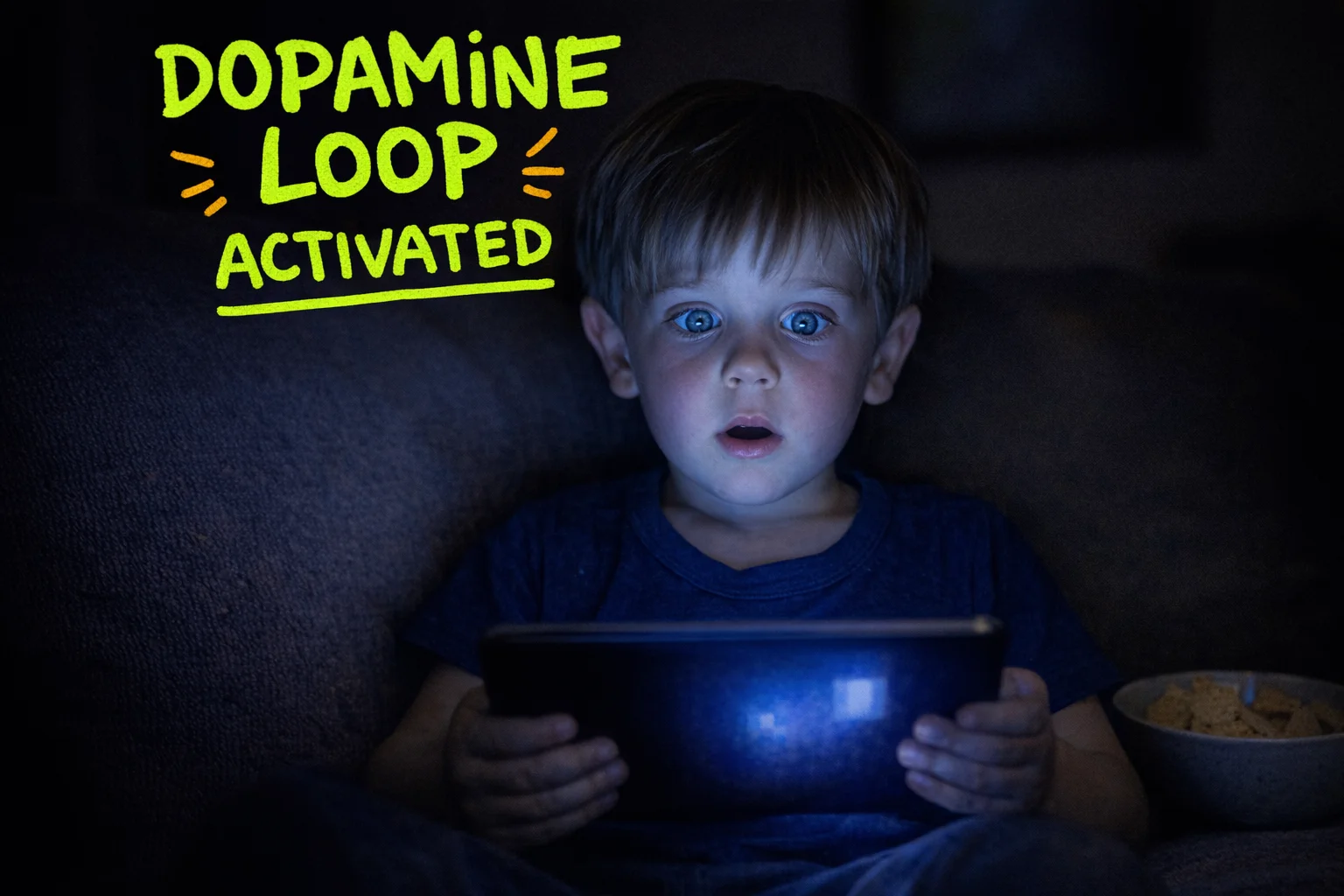 TikTok didn’t create this vulnerability. It just found it, measured it to four decimal places, and built a business model on top of it.
Children systematically underestimate physical risk because they have limited experience AND reduced anxiety about consequences, a combination that produces what researchers call an optimistic bias. [18] [20] They’re not brave. They’re just running on a system that hasn’t yet learned to be afraid of the right things.
You are not raising a feral animal. You are raising a human whose brain is doing exactly what evolution designed it to do, in exactly the sequence it was always going to do it. The dandelion incident was inevitable. The YouTube spiral was inevitable. Your frustration is valid, your parenting is fine, and the foreman will eventually show up.
Around age 25.
The right slope: your dad’s brain isn’t broken, it’s just running a very old version of the software
Here is what happened. Someone called your dad. They said they were from Microsoft. They said his computer had a virus — a serious one, the kind that could steal his bank information — and that for $400 they could fix it remotely, right now, today. Your dad said, “Oh, how wonderful, thank you so much for catching that.” He got out his credit card. He felt relieved.
You found out three days later.
 The face of a man who just solved a problem, paid a professional, and feels genuinely great about it.
And here is the thing that will either comfort you or haunt you: he wasn’t being stupid. His brain was doing exactly what a brain in its position does. It was just doing it with hardware that has been quietly, measurably changing since before either of you noticed.
Processing speed: the original decline
The first thing to go isn’t memory. It’s speed. Processing speed — how fast the brain takes in new information, evaluates it, and produces a response — starts declining in your 30s and moves in a fairly straight line from there, with the slope steepening noticeably after about 60 to 65. [13] [32] This is not a dramatic cliff. It’s a long, gradual ramp. But by the time your dad is fielding a phone call from a fast-talking “Microsoft technician” who is deliberately piling on urgency and technical jargon, the gap between how fast the scammer is moving and how fast your dad can process what’s happening is real and measurable. Slower processing speed predicts worse outcomes across almost every functional domain — greater accident risk, reduced independence, higher risk of memory problems. [30] The scammer, consciously or not, is exploiting a known vulnerability.
Working memory: the whiteboard is smaller now
Working memory is the mental whiteboard where you hold information while you’re actively using it. Your dad’s whiteboard has gotten smaller. Not because he’s losing his mind, but because the prefrontal cortex — the region that runs working memory — loses specific glutamate receptors with age, and those receptors matter enormously for holding and manipulating information under load. [37] [38] On a calm Tuesday with no pressure, he’s fine. On a phone call where he’s simultaneously trying to remember what the guy just said, evaluate whether it sounds legitimate, recall whether he’s heard about this kind of scam, and decide what to do — that’s a high-demand manipulation task, and high-demand manipulation tasks are exactly where age-related working memory deficits show up most. [40]
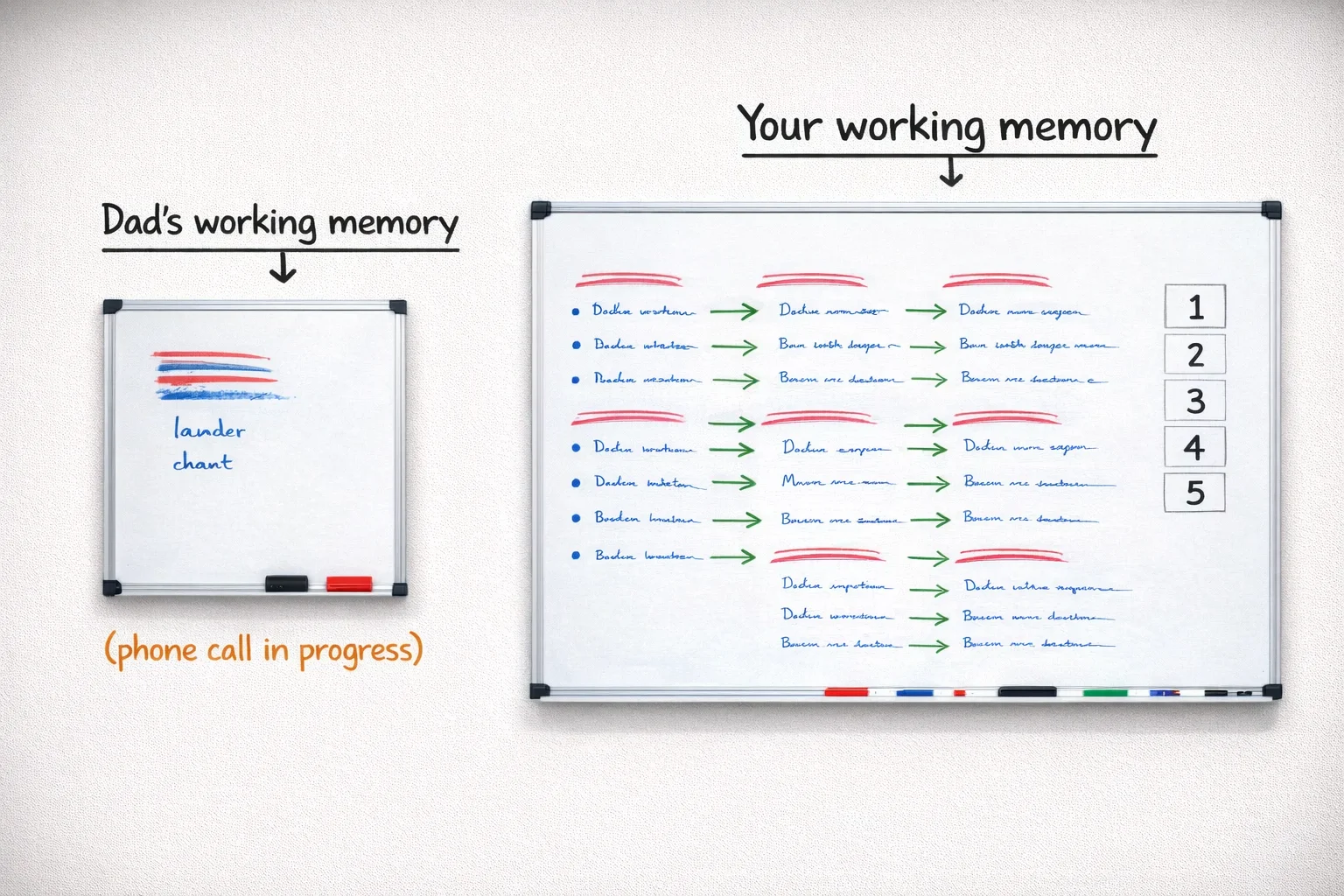 Working memory under load: one whiteboard is trying to track a phone scammer, recall prior warnings, evaluate credibility, and make a financial decision — simultaneously.
Executive function: the editor is getting tired
Executive function is the brain’s editor. It catches the thing that doesn’t add up. It says, “Wait, why would Microsoft call me specifically?” It inhibits the impulse to comply before the full picture is assessed. In aging brains, inhibitory control and cognitive flexibility show the largest age-related losses of any executive domain, and those losses track closely with deteriorating white-matter connectivity — the structural wiring that lets different brain regions talk to each other efficiently. [40] [42] [43] One longitudinal study found that roughly 82.5% of measured executive decline could be attributed to changes in that connectivity. [42] The editor isn’t gone. It’s just slower to catch the manuscript before it goes to print.
The positivity effect: the cruelest part
This is where it gets genuinely poignant, and also where the scam industry has found its most reliable exploit. Laura Carstensen’s Socioemotional Selectivity Theory describes something called the positivity effect: as people age and their time horizon shortens, they naturally shift attention toward positive information and away from negative information. [41] This is mostly adaptive. It’s why your dad seems more content than he was at 45, why he doesn’t sweat small things, why he’s genuinely pleasant to be around in a way he maybe wasn’t when he was grinding through middle age.
But it also means that when a warm, authoritative voice calls and says “we’re here to help you, we caught this early, you’re going to be fine” — that framing lands. It lands hard. The positivity effect draws attention toward the reassuring parts of the interaction and reduces scrutiny of the warning cues. [35] [41] The scammer wasn’t just lucky. He was, functionally, running a social engineering attack optimized for an aging brain’s actual neurological profile.
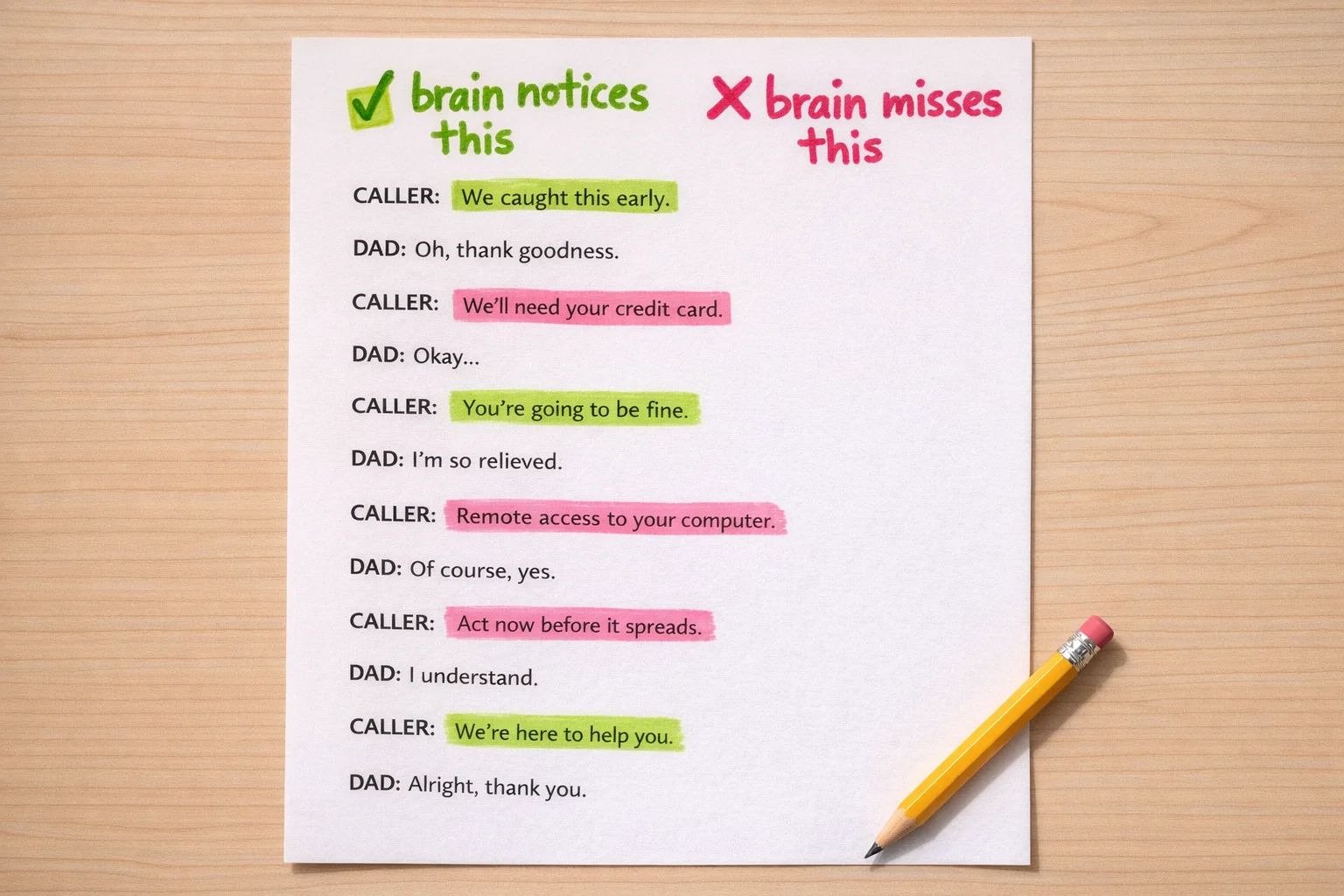 The scammer didn’t get lucky — he was running a social engineering script optimized for exactly how an aging brain processes emotional information.
The brain rot parallel nobody wants to admit
And then there’s the other screen problem. Not the scam — the spiral. Your mom has been on Facebook for four hours. Not because she meant to be. She clicked on a video of a golden retriever, which led to a compilation of golden retrievers, which led to a “you won’t believe what this dog did” story, which led to a comment section argument about something political, which she is now reading with her whole chest. Your dad has been playing a mobile game — the kind with the little cartoon coins and the spinning wheel — since 10 a.m. It is now 2 p.m.
This is the aging-parent version of the TikTok spiral, and it works for the same reason the kid version works, just through a slightly different mechanism. Autoplay and infinite scroll are designed to exploit the brain’s reward circuitry. In older adults, the combination of reduced inhibitory control (the executive function that says “okay, that’s enough, close the app”) and the positivity effect (each new video is a small, pleasant hit) creates a feedback loop that is genuinely hard to interrupt. [41] [43] The difference between your teenager’s four-hour YouTube session and your father’s four-hour Facebook session is mostly aesthetic. The underlying mechanism — a brain whose brakes are not fully engaged, being fed an optimized stream of low-effort reward — is the same.
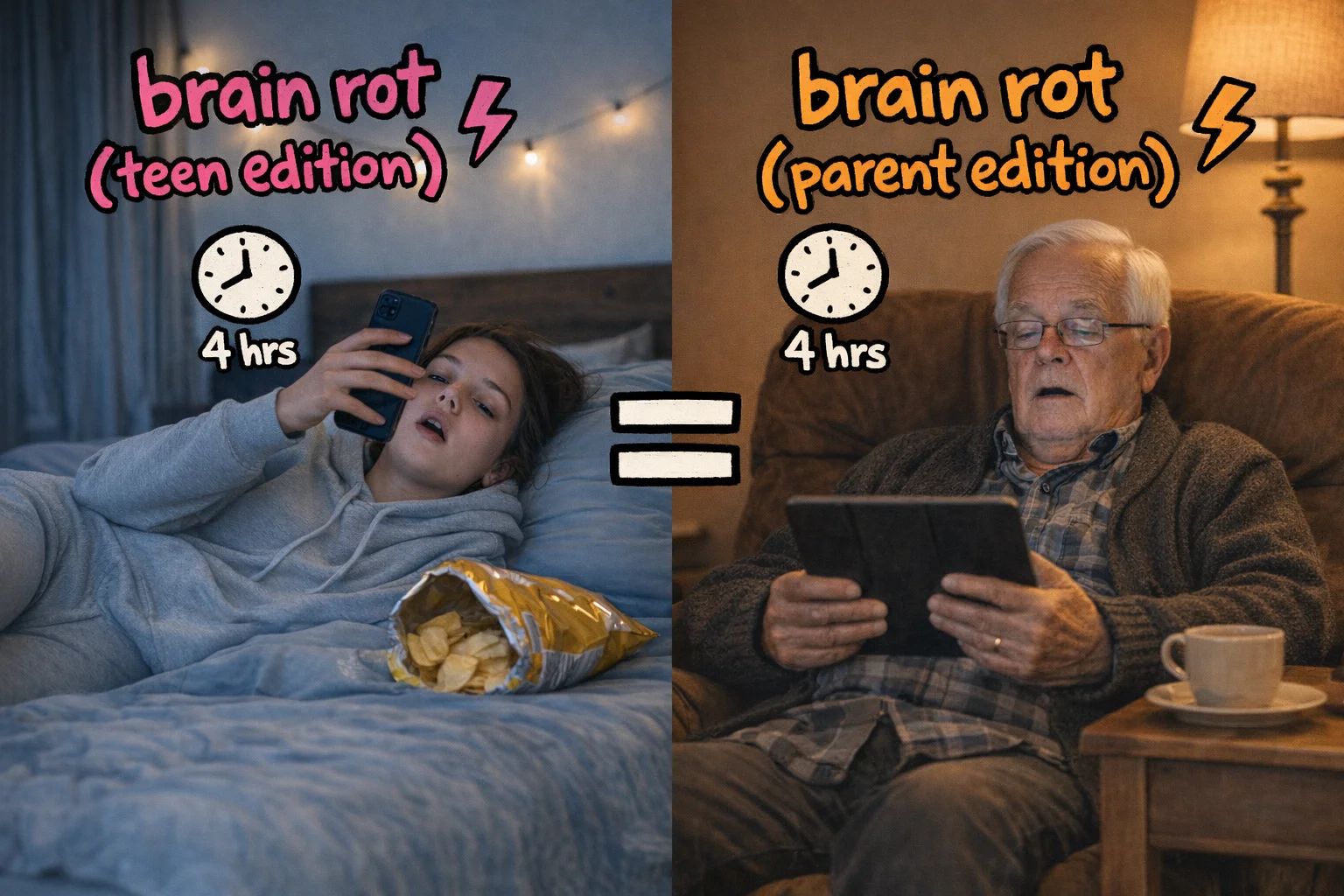 Different aesthetics, different devices, different decades — same disengaged prefrontal cortex, same optimized reward loop, same glazed expression.
You have, at this point, had the screen time conversation with both of them. It went about as well both times.
The reason it’s hard to be angry — really, sustainingly angry — once you understand the neuroscience is that none of this is a character flaw. Your dad didn’t send $400 to a scammer because he’s gullible or careless. He sent it because his processing speed couldn’t keep up with a professional manipulator, his working memory was overwhelmed by a high-load situation, his executive function’s inhibitory control didn’t catch the red flags fast enough, and his brain’s positivity bias made the warm, helpful framing feel true. That’s not a moral failure. That’s a Tuesday for a brain that has been running for 70-something years and is doing its honest best.
The guilt you feel about being frustrated with him? You can put that down now. The frustration itself makes complete sense. So does the love underneath it.
Congratulations, you are the frontal lobe now
Here is what nobody tells you when you become a parent, and what nobody tells you again when your parents start to need you: at some point, quietly and without ceremony, you become the executive function of the entire operation. Not the CEO. Not the manager. The actual prefrontal cortex. The biological structure responsible for inhibitory control, risk assessment, forward planning, and the ability to pause before doing something catastrophically stupid.
You are doing this job for a six-year-old who wants to jump off the garage roof because he saw it on YouTube, AND for a seventy-one-year-old who wants to wire $4,000 to a cryptocurrency wallet recommended in a Facebook ad from an account called “Wealth Eagle Official.” Same job. Different patient. Zero additional pay.
This is not a metaphor. The prefrontal cortex is the part of the brain that says wait, let’s think about this. Your six-year-old’s version is structurally unfinished and won’t be done for another two decades. Your parent’s version is, depending on age and health, running slower, filtering less, and increasingly susceptible to the kind of impulsive optimism that makes a Facebook ad look like a legitimate financial opportunity. You, at 36 or 39 or 41, are at the peak of your prefrontal function. Which means you are the only one in the room who can do this job. Lucky you.
And you are doing it ALL DAY.
The tank is real, even if the science is messy
In 1998, Roy Baumeister and colleagues ran an experiment where they made people resist eating chocolate and eat radishes instead, then asked them to persist on unsolvable puzzles. The radish group quit about 19% sooner. [45] This became the founding evidence for “ego depletion,” the idea that self-control draws from a finite daily resource, and that spending it on one thing leaves less for the next thing.
The problem is that a 2016 multi-lab replication with over 2,000 participants found essentially no effect, an effect size of approximately zero. [44] [47] More recent meta-analyses find small, inconsistent effects in the range of d = 0.10 to 0.20, with researchers increasingly arguing that what looks like “depletion” is actually reduced motivation or disengagement rather than a literal physiological resource running dry. [46] [48]
So the strict version of ego depletion, the idea that your willpower is a muscle that physically exhausts, probably isn’t right. But here is what IS well-established: cognitive load theory, which has held up considerably better. Working memory has a hard capacity limit. [49] [50]
When you exceed it by stacking intrinsic demands (the actual complexity of a decision) on top of extraneous demands (interruptions, emotional noise, competing requests), decision quality degrades. You make worse calls. You miss things. You say yes when you should say no, or no when you should have asked a follow-up question. Stress and anxiety make this worse by further compressing working memory capacity. [51]
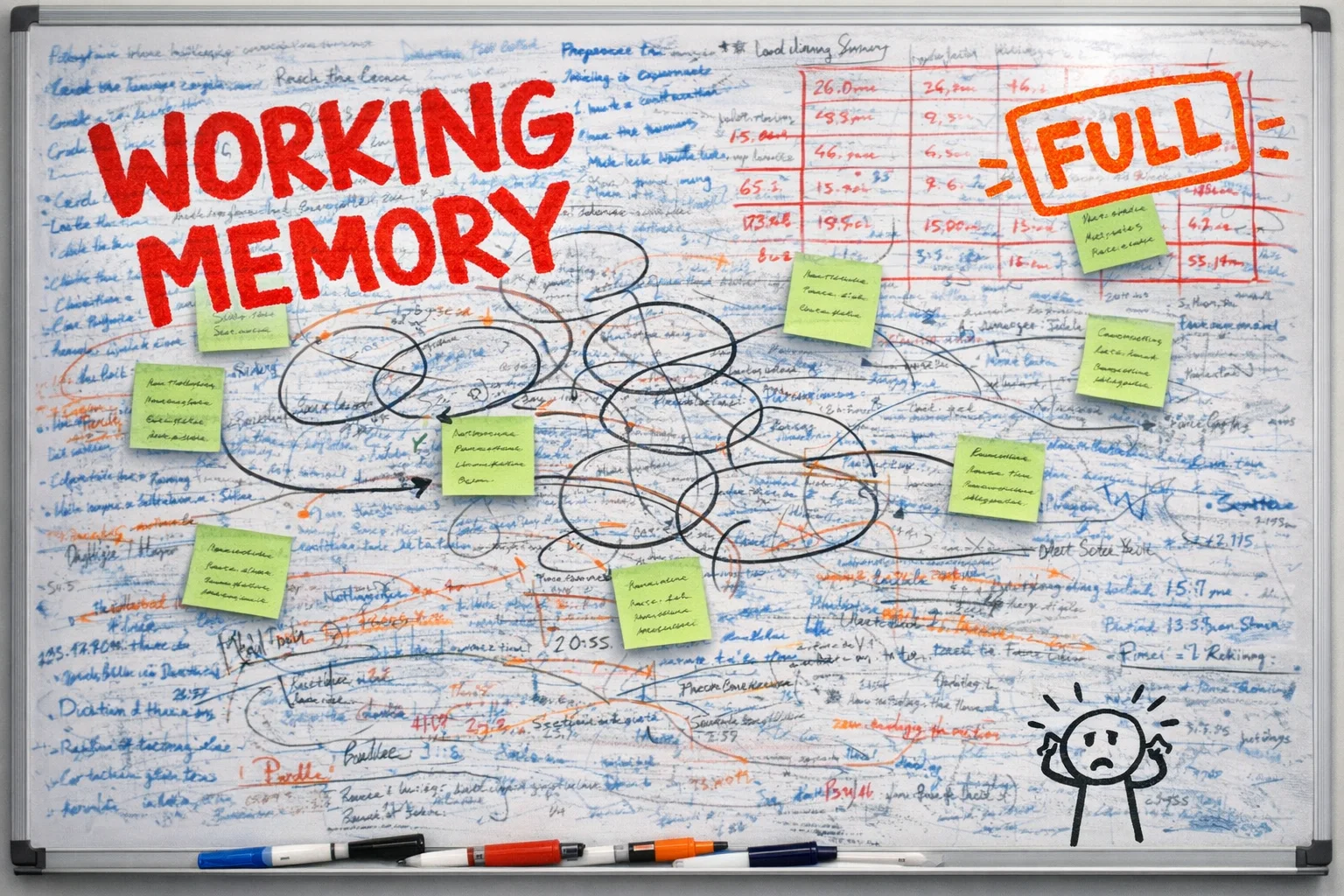 Working memory at 4:47 PM on a Tuesday when someone asks you to ‘just make a quick decision.’
You are not imagining the cognitive weight. The mechanism is real, even if the original metaphor was slightly wrong. You are not a muscle that fatigues. You are a processor running too many programs, and some of them are other people’s emergencies.
The sandwich generation tax
Research on sandwich-generation caregivers, people simultaneously raising children and supporting aging parents, consistently finds elevated rates of mental health decline, physical health problems, burnout, and financial strain compared to people doing only one of those things. [53] [55] Providing significant time to BOTH generations is associated with nearly double the odds of severe psychological distress. [57] Intensive caregiving above twenty hours per week links to sustained mental health deterioration over time. [56]
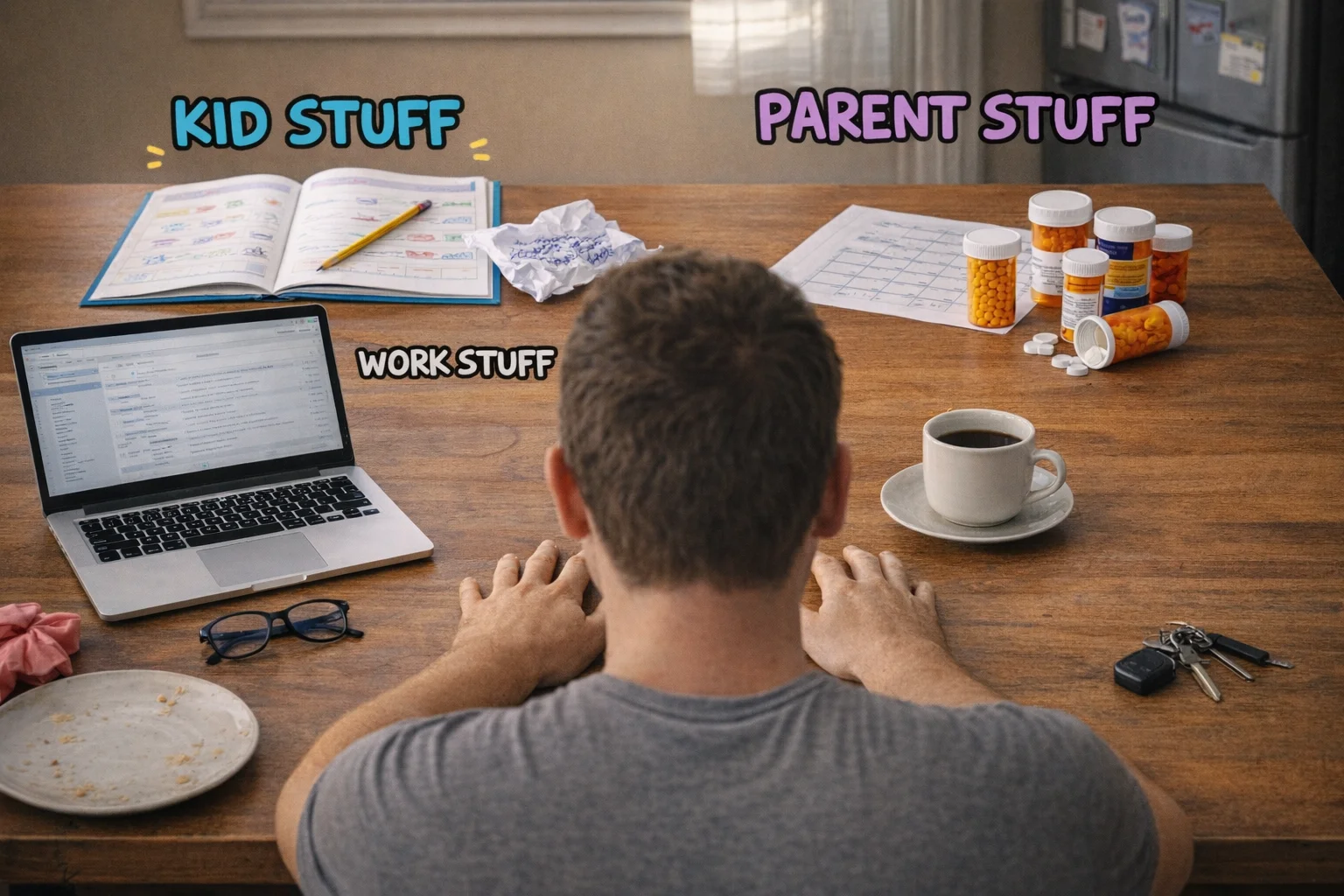 The coffee has been cold for two hours. No one noticed. Especially not you.
None of this is surprising if you are living it. What might be surprising is that the exhaustion you feel after a day of managing your mother’s doctor’s appointment logistics AND negotiating with your eight-year-old about screen time AND making seventeen small decisions at work is not weakness or poor time management. It is a predictable output of running executive function for multiple humans simultaneously, on a system that has real capacity limits, under conditions of chronic stress that compress those limits further.
You are not burned out because you are bad at this. You are burned out because you are doing a job that was never meant to be done by one brain for this many people at once.
Go ahead. Laugh. Science says it’s better that way.
Here is the thing nobody tells you when you are standing in the kitchen, simultaneously explaining to a six-year-old why they cannot eat cake for breakfast AND explaining to a seventy-two-year-old diabetic parent why they also cannot eat cake for breakfast: you are allowed to find this funny. Not in a cruel way. Not in a “I resent these people” way. In a “this situation is so structurally absurd that laughter is the only rational response” way.
That distinction matters, and it has a name.
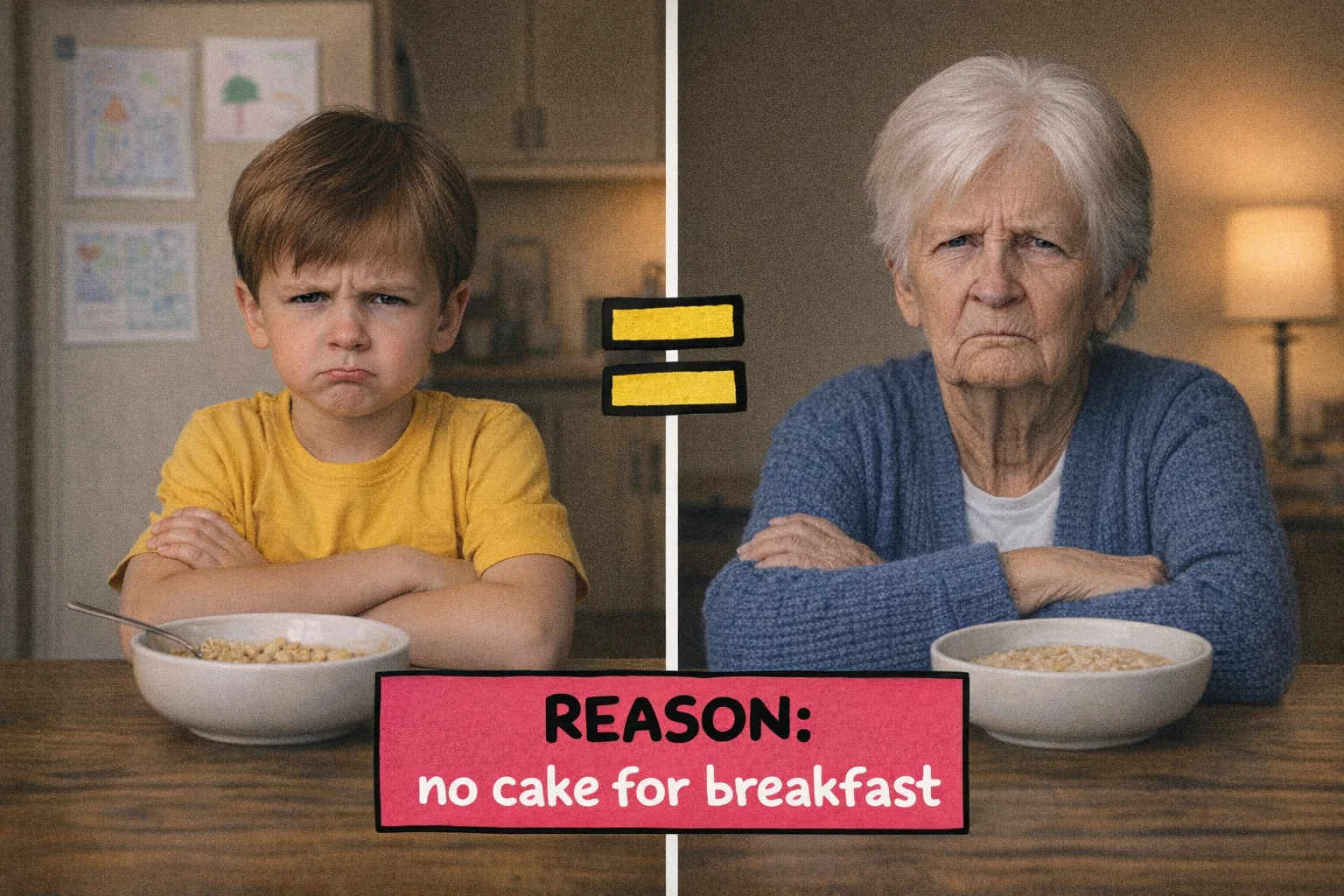 Different decades, identical energy — the stubborn crossed-arms pose that transcends age and makes you question everything.
Psychologists Peter McGraw and Caleb Warren developed Benign Violation Theory to explain why things are funny. The short version: humor happens when something feels like a violation of how the world should work AND simultaneously feels harmless or distant enough that you are not actually threatened by it.
Your mother forwarding a Facebook post warning that 5G towers are harvesting her memories? Violation of logic. Harmless to you, ultimately. FUNNY. Your kid staging a full courtroom-style appeal against bedtime, complete with witnesses (the dog)? Violation of the social order. Stakes: zero. Funny.
The psychological distance is doing the work. You are not laughing AT them. You are laughing at the beautiful, maddening absurdity of the situation you have been placed in by the universe.
And here is where it gets genuinely useful rather than just validating: that laughter is doing something real inside your body. Studies show humor as a coping strategy is associated with lower perceived stress and reduced distress. [59] [61] It reduces cortisol. It releases endorphins. [62] But the deeper mechanism is cognitive reappraisal, which is the mental act of looking at a stressful situation and choosing to frame it differently. When you find something funny instead of infuriating, your prefrontal cortex is doing exactly what it is supposed to do: it is stepping in, moderating your amygdala’s alarm response, and reframing the threat. [63] [64] That is not avoidance. That is emotional regulation. That is, technically, a sign of a functioning adult brain, which, given everything this post has covered, you should feel good about having.
Sandwich-generation caregivers carry genuinely elevated rates of depression, anxiety, and guilt. [69] [73] The guilt, specifically, is the part that makes the frustration worse, because you cannot even vent without immediately feeling like a monster.
So consider this the formal permission structure you were looking for. The laughter is not cruelty. The frustration is not a character flaw. Both are documented, physiologically measurable responses to an objectively difficult situation that you did not design and cannot fully control.
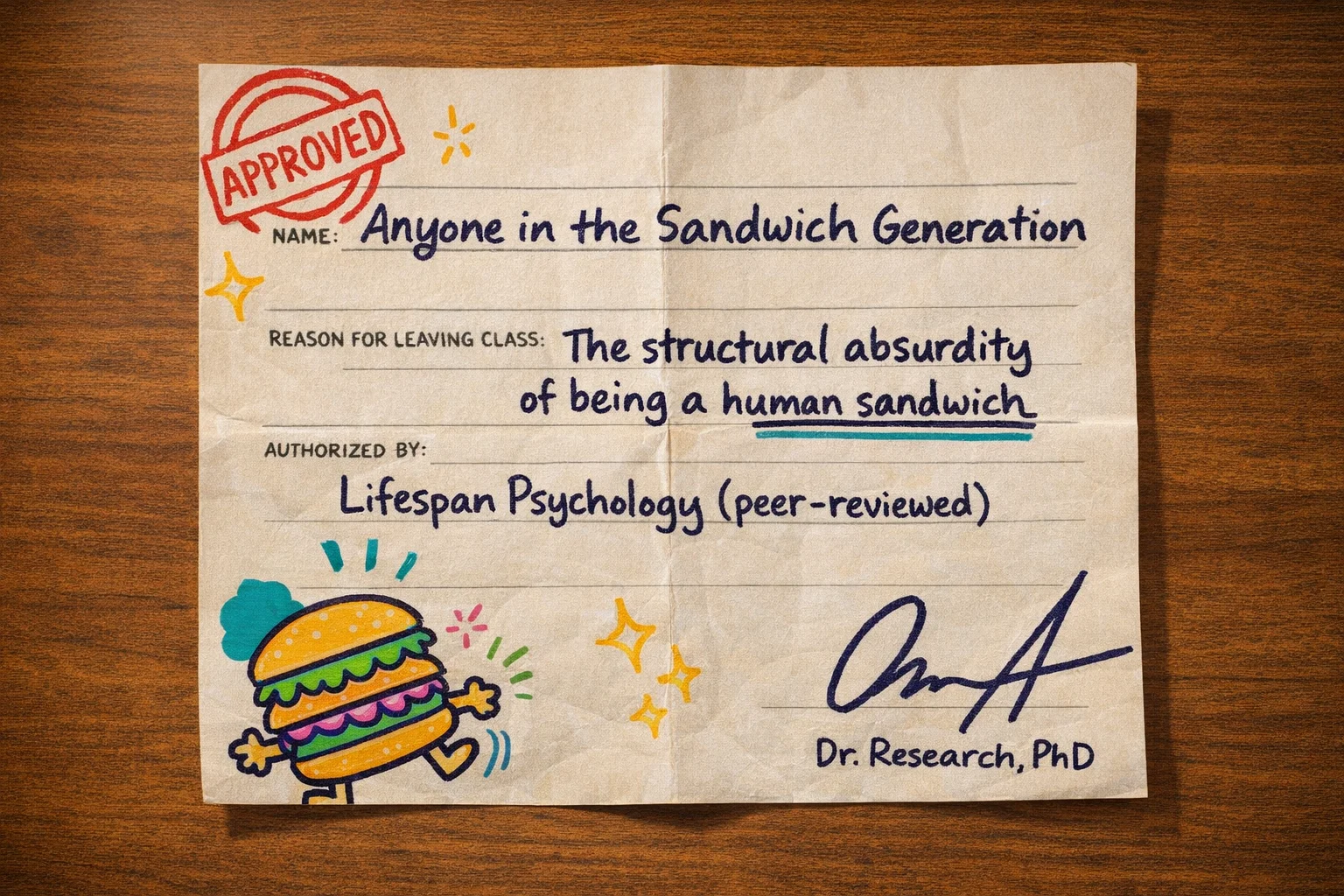 Officially excused: your permission slip to find the whole situation completely, legitimately hilarious.
You are not a bad parent for finding your child’s meltdown darkly hilarious in retrospect. You are not a bad child for texting your sibling a screenshot of your father’s latest conspiracy theory with three crying-laughing faces. You are a person using humor as a buffer between a stressful reality and your own mental health, which is exactly what the research says adaptive humor does. [61]
And look. I am thirty-something, writing this from the comfortable middle of the U, feeling very smug about my processing speed and my executive function and my ability to assess risk without either crying or wiring money to a stranger.
I know what is coming.
The slope goes both ways. One day I will be the one confidently giving my children unsolicited advice about something I am completely wrong about. I will be the one who cannot figure out whatever the 2047 equivalent of a smartphone is. I will be the one my kids are texting each other about, with the crying-laughing faces.
So to my children: I see you. I know it is frustrating. Go ahead and laugh. I am pre-emptively giving you permission.
Sources
[1] Fluid and Crystallized Intelligence — https://www.simplypsychology.org/fluid-crystallized-intelligence.html
[2] PMC article (referenced in section) — https://pmc.ncbi.nlm.nih.gov/articles/PMC5156710/
[3] Fluid and crystallized intelligence — Wikipedia — https://en.wikipedia.org/wiki/Fluid_and_crystallized_intelligence
[4] CHC Model (blog/explainer) — https://www.sapa-project.org/blogs/CHCmodel.html
[5] When Is the Brain Mature? — https://dana.org/article/when-is-the-brain-mature/
[6] PMC article on brain maturation (referenced) — https://pmc.ncbi.nlm.nih.gov/articles/PMC2892678/
[7] When the Brain Starts ‘Adulting’ — https://www.brainfacts.org/thinking-sensing-and-behaving/aging/2018/when-the-brain-starts-adulting-112018
[8] Feature: Neuroscience and the teen brain — https://www.apa.org/monitor/2022/07/feature-neuroscience-teen-brain
[9] Cognitive control and aging (article summary) — https://neurosciencenews.com/cognitive-control-aging-neuroscience-29653/
[10] PubMed entry (referenced cognitive aging study) — https://pubmed.ncbi.nlm.nih.gov/25770099/
[11] Science Advances article (doi:10.1126/sciadv.ads1560) — https://www.science.org/doi/10.1126/sciadv.ads1560
[12] PMC article on cognitive aging (referenced) — https://pmc.ncbi.nlm.nih.gov/articles/PMC11447525/
[13] PMC article (Hartshorne & Germine / related large-sample findings referenced) — https://pmc.ncbi.nlm.nih.gov/articles/PMC4906299/
[14] News: Brain peaks at different ages (MIT News summary of large study) — https://news.mit.edu/2015/brain-peaks-at-different-ages-0306
[15] What a decades-long study teaches us about brain health and aging — https://give.uwmedicine.org/stories/what-a-decades-long-study-teaches-us-about-brain-health-and-aging/
[16] Prefrontal cortex development & age — https://www.simplypsychology.org/prefrontal-cortex-development-age.html
[17] Brain development during adolescence — https://courses.lumenlearning.com/wm-lifespandevelopment/chapter/brain-development-during-adolescence/
[18] Brain development — teens (overview) — https://raisingchildren.net.au/pre-teens/development/understanding-your-pre-teen/brain-development-teens
[19] Under the Hood: The Adolescent Brain — https://hms.harvard.edu/news/under-hood-adolescent-brain
[20] PMC article (review) on limbic–prefrontal development — https://pmc.ncbi.nlm.nih.gov/articles/PMC10204580/
[21] PMC article on adolescent brain development — https://pmc.ncbi.nlm.nih.gov/articles/PMC4086855/
[22] Why meltdowns and anxiety aren’t ‘bad behavior’ — it’s the amygdala (blog) — https://mendability.com/post/why-meltdowns-and-anxiety-arent-bad-behavior-its-the-amygdala-mostly
[23] My amygdala made me do it (parent/education explainer) — https://raintreemontessori.org/current/my-amygdala-made-me-do-it/
[24] The Emotional Brain Under Construction (PDF) — https://www.zerotothree.org/wp-content/uploads/2022/10/The-Emotional-Brain-Under-Construction.pdf
[25] Amygdala — https://my.clevelandclinic.org/health/body/24894-amygdala
[26] Review on hot and cold cognition / executive functions (PMC) — https://pmc.ncbi.nlm.nih.gov/articles/PMC8076773/
[27] Hot and Cold Cognition (overview PDF) — https://justicelab.columbia.edu/sites/default/files/content/Hot%20and%20Cold%20Cognition.pdf
[28] Frontiers article (molecular neuroscience) — relevant to interneuron/PV maturation — https://www.frontiersin.org/journals/molecular-neuroscience/articles/10.3389/fnmol.2012.00055/full
[29] Adolescent brain development (overview) — https://www.kidshealth.org.nz/adolescent-brain-development
[30] PMC article (PMC9896833) — processing speed & aging (section source) — https://pmc.ncbi.nlm.nih.gov/articles/PMC9896833/
[31] Study identifies a potential biomarker for decreased brain processing speed in aging — https://cam.mbi.ufl.edu/2020/09/02/study-identifies-a-potential-biomarker-for-decreased-brain-processing-speed-in-aging/
[32] Frontiers in Aging Neuroscience article (2017) — processing speed across adulthood — https://www.frontiersin.org/journals/aging-neuroscience/articles/10.3389/fnagi.2017.00062/full
[33] Slower Decline in Processing Speed Is Associated (Karger Gerontology article) — https://karger.com/ger/article/68/1/17/828352/Slower-Decline-in-Processing-Speed-Is-Associated
[34] Brain aging explained — what speeds it up and what we can do to slow it down — https://www.americanbrainfoundation.org/brain-aging-explained-what-speeds-it-up-and-what-we-can-do-to-slow-it-down/
[35] Memory, age and dementia — Stanford Medicine insights — https://med.stanford.edu/news/insights/2024/03/memory-age-dementia-healthy-brain.html
[36] Study reveals the surprising age at which your brain reaches its peak — https://www.sciencealert.com/study-reveals-the-surprising-age-at-which-your-brain-reaches-its-peak
[37] Working-memory decline in normal aging linked to loss of specific receptor (UF Health news) — https://ufhealth.org/news/2016/working-memory-decline-normal-aging-linked-loss-specific-receptor
[38] PMC article (PMC3825012) — working memory and aging (review/research) — https://pmc.ncbi.nlm.nih.gov/articles/PMC3825012/
[39] A dynamic approach to understanding age-related memory decline — https://www.cogneurosociety.org/a-dynamic-approach-to-understanding-age-related-memory-decline/
[40] Frontiers in Aging Neuroscience (2019) — working memory / aging review — https://www.frontiersin.org/journals/aging-neuroscience/articles/10.3389/fnagi.2019.00126/full
[41] Memory and brain changes in aging — APA overview — https://www.apa.org/topics/aging-older-adults/memory-brain-changes
[42] Cerebral Cortex article (2017) — structural connectivity and executive decline — https://academic.oup.com/cercor/article/27/3/2303/3056337
[43] PMC article (PMC9945216) — executive functions & aging (cross-sectional/longitudinal evidence) — https://pmc.ncbi.nlm.nih.gov/articles/PMC9945216/
[44] Ego depletion - Wikipedia — https://en.wikipedia.org/wiki/Ego_depletion
[45] Ego Depletion: Is the Active Self a Limited Resource? (Baumeister et al., 1998) [PDF] — [https://faculty.washington.edu/jdb/345/345%20Articles/Baumeister%20et%20al.%20(1998](https://faculty.washington.edu/jdb/345/345%20Articles/Baumeister%20et%20al.%20(1998)\)\.pdf
[46] PubMed Central article (review/meta-analysis relevant to ego depletion) — https://pmc.ncbi.nlm.nih.gov/articles/PMC6013521/
[47] The Collapse of Ego Depletion — https://www.speakandregret.michaelinzlicht.com/p/the-collapse-of-ego-depletion
[48] Rethinking Willpower: The Shifting Science of Ego Depletion — https://thegeekyleader.com/2024/05/05/rethinking-willpower-the-shifting-science-of-ego-depletion/
[49] PMC article on Cognitive Load Theory / working memory (educational psychology resource) — https://pmc.ncbi.nlm.nih.gov/articles/PMC12246501/
[50] Cognitive Load Theory — The Decision Lab (reference guide) — https://thedecisionlab.com/reference-guide/psychology/cognitive-load-theory
[51] Journal article on stress, anxiety and working memory (SAGE Journals DOI 10.1177/0963721420922183) — https://journals.sagepub.com/doi/10.1177/0963721420922183
[52] Cognitive Load Theory — Faculty Quick Guide [PDF] — https://www.mcw.edu/-/media/MCW/Education/Academic-Affairs/OEI/Faculty-Quick-Guides/Cognitive-Load-Theory.pdf
[53] Mental and Physical Health among Sandwich Generation Working-Age (Penn State repository) — https://pure.psu.edu/en/publications/mental-and-physical-health-among-sandwich-generation-working-age-/
[54] Frontiers in Public Health article on sandwich generation (2025) — https://www.frontiersin.org/journals/public-health/articles/10.3389/fpubh.2025.1730220/full
[55] Sandwich generation study shows challenges caring both kids and aging parents (Michigan Medicine summary) — https://www.michiganmedicine.org/health-lab/sandwich-generation-study-shows-challenges-caring-both-kids-and-aging-parents
[56] PubMed entry (study on caregiving prevalence / effects; 2023?) — https://pubmed.ncbi.nlm.nih.gov/37312495/
[57] National Alliance for Caregiving — Sandwich Caregiving Report [PDF] — https://caringacross.org/wp-content/uploads/2024/01/NAC_SandwichCaregiving_Report_digital112019.pdf
[58] PubMed entry (study on caregiving/burnout; 2024/2025?) — https://pubmed.ncbi.nlm.nih.gov/41552895/
[59] PMC article (PMC9952361) — humor as a coping strategy (listed as source 1 in section) — https://pmc.ncbi.nlm.nih.gov/articles/PMC9952361/
[60] Digital repository thesis/article (UNM) — humor/resilience (listed as source 2 in section) — https://digitalrepository.unm.edu/cgi/viewcontent.cgi?article=1391&context=psy_etds
[61] PMC article (PMC10936143) — humor, coping, moderation effects (listed as source 3 in section) — https://pmc.ncbi.nlm.nih.gov/articles/PMC10936143/
[62] The Good Trade — ‘Humor as a coping mechanism’ (popular-press explainer) (listed as source 4) — https://www.thegoodtrade.com/features/humor-coping-mechanism/
[63] PMC article (PMC10149752) — cognitive reappraisal / emotion regulation (listed as reappraisal source 2) — https://pmc.ncbi.nlm.nih.gov/articles/PMC10149752/
[64] Frontiers in Systems Neuroscience (2014) — neural mechanisms of emotion regulation (listed as reappraisal source 3) — https://www.frontiersin.org/journals/systems-neuroscience/articles/10.3389/fnsys.2014.00175/full
[65] PMC article (PMC6188704) — meta-analytic evidence on reappraisal and outcomes (listed as reappraisal source 4) — https://pmc.ncbi.nlm.nih.gov/articles/PMC6188704/
[66] McGraw & Warren (2010) — Benign Violation Theory (original paper / PDF) — https://leeds-faculty.colorado.edu/mcgrawp/pdf/mcgraw.warren.2010.pdf
[67] PMC article (PMC6593112) — benign violation / humor theory related empirical work (listed as source 6) — https://pmc.ncbi.nlm.nih.gov/articles/PMC6593112/
[68] Peter McGraw — ‘A brief introduction to the Benign Violation Theory of Humor’ (author site / overview) — https://petermcgraw.org/a-brief-introduction-to-the-benign-violation-theory-of-humor/
[69] PMC article (PMC11616165) — sandwich generation / caregiver mental health (listed as caregiver source 1) — https://pmc.ncbi.nlm.nih.gov/articles/PMC11616165/
[70] PositivePsychology.com — ‘Humor Psychology’ (overview of humor styles and effects) (listed as source 9 in humor list) — https://positivepsychology.com/humor-psychology/
[71] Psychology Today — ‘Cognitive reappraisal’ (accessible overview) (listed as reappraisal source 5) — https://www.psychologytoday.com/us/basics/cognitive-reappraisal
[72] McGraw & Warren (2014) — Benign Violation Theory follow-up / review (PDF) — https://leeds-faculty.colorado.edu/mcgrawp/pdf/mcgraw.warren.2014.pdf
[73] NAMI Blog — ‘Using Humor as a Coping Tool’ (practical/organizational resource) — https://www.nami.org/Blogs/NAMI-Blog/January-2020/Using-Humor-as-a-Coping-Tool
If you read this far, you'll like what's next.
One essay a month, roughly. No noise, no sponsored content, no threads.